Laser fibroma removal in Wrocław is a quick, minimally invasive way to get rid of small, benign skin lesions with a fractional CO2 laser - without a scalpel and without stitches. At MM Clinic the treatment is performed by Michał Marciniak, MD. Every lesion is first assessed by a doctor - safety depends on correct assessment of suitability, not on the technique alone. Below you will find complete information: what a fibroma is, how laser fibroma removal works, the indications, contraindications, results and current prices in Wrocław.
Contents
- What is a fibroma and how does it differ from a wart or a mole?
- Types of fibromas
- When should you see a doctor?
- How to prepare for laser fibroma removal
- The treatment step by step
- CO2 laser or surgery - which to choose?
- Indications for laser fibroma removal
- Contraindications
- What does recovery after the treatment look like?
- Results of the treatment
- Prices of laser fibroma removal in Wrocław
- Practical information
- Frequently asked questions (FAQ)
- Treatment performed by Michał Marciniak, MD
- Sources
What is a fibroma and how does it differ from a wart or a mole?
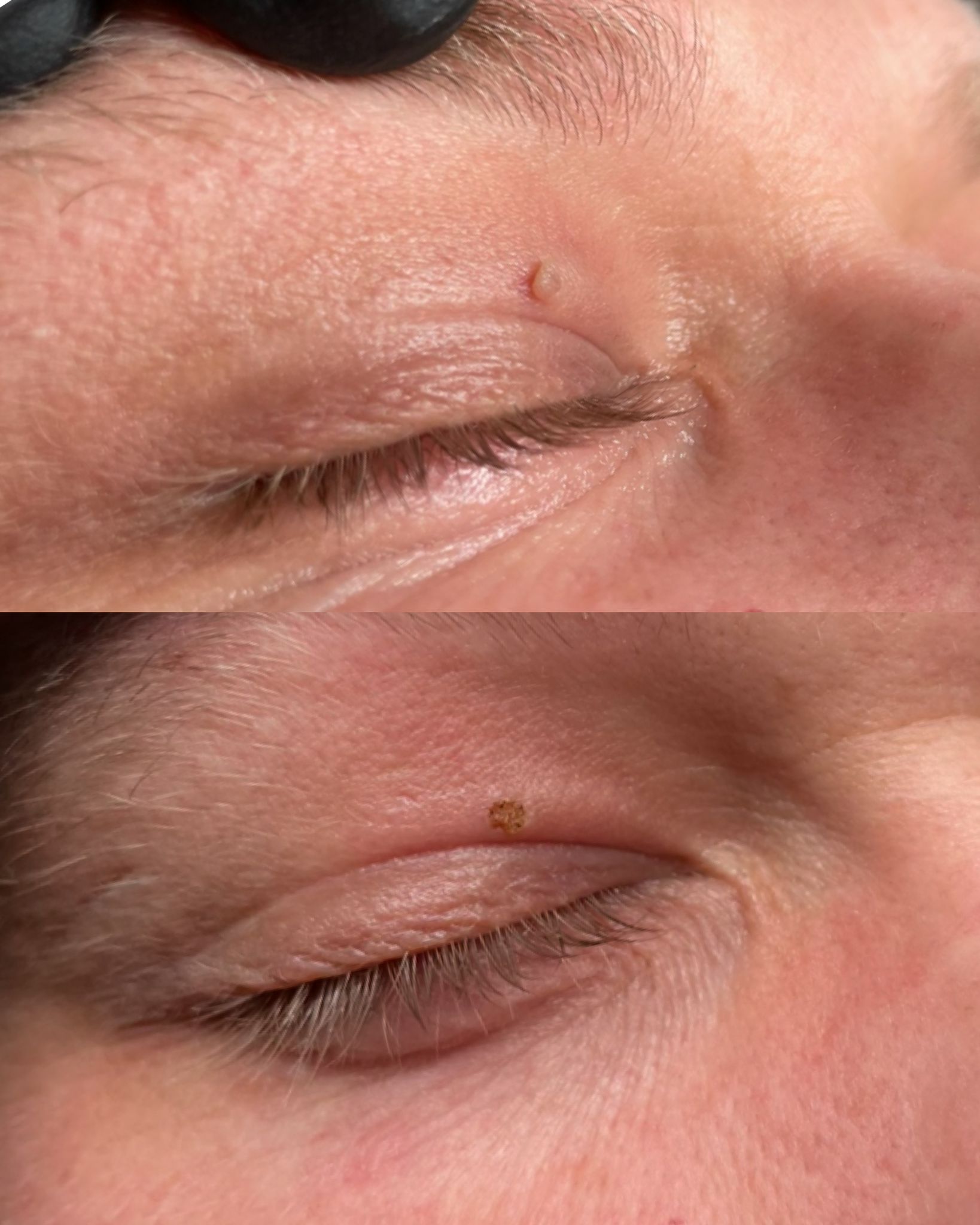
A fibroma is a benign skin lesion made up of connective (fibrous) tissue - unlike pigmented moles, which are formed by pigment cells, and unlike warts, which are of viral origin. The most common type is the soft fibroma (a skin tag, Latin acrochordon) - a small, stalked lesion, usually 2–5 mm in size, that appears in areas of friction: on the neck, the back of the neck, in the armpits, on the eyelids or in the groin. It can be irritated by clothing, jewellery or a belt [3].
During laser fibroma removal, the lesion is precisely vaporised with the CO2 laser beam. The laser acts only on the altered tissue and seals small blood vessels, which is why the procedure is precise, causes little bleeding and the risk of scarring is minimal [1][2]. Correctly identifying the type of lesion is the doctor's job - which is why the treatment is always preceded by a consultation.
In brief: soft fibromas (skin tags) respond best to the CO2 laser. Pigmented moles, viral warts and atypical lesions require a separate assessment - the method is always decided by the doctor.
Types of fibromas
- Soft fibroma (skin tag, acrochordon) - soft, stalked, found in skin folds; ideal for removal with a CO2 laser.
- Hard fibroma (dermatofibroma) - a firm nodule in the dermis, most often on the limbs; it extends deeper, so it usually requires assessment and often a surgical method.
The method is always chosen by the doctor after examining the lesion - not every type of fibroma is suitable for laser removal.
Important: we use the laser to remove only lesions that are clearly benign and have been assessed as suitable during the consultation. The treatment vaporises the tissue, so it does not allow a histopathological examination. If a lesion looks atypical or raises any doubts, we refer the patient for surgical excision with histopathological examination - the only safe route in such cases.
When should you see a doctor?
A typical soft fibroma is harmless. However, lesions that grow quickly, change colour, bleed, are painful, ulcerated or look atypical require a consultation. Such lesions are not removed with a laser "on the spot" - they must first be assessed and, if necessary, excised and examined histopathologically.
How to prepare for laser fibroma removal
Preparing for the treatment is simple, but a few rules improve safety and comfort:
- come to the consultation without make-up around the lesion; do not cover or irritate the fibroma before the visit;
- tell the doctor about any medicines you take (especially anticoagulants and photosensitising drugs, e.g. isotretinoin) and about any tendency to form keloids;
- there should be no active cold sores or skin infection at the treatment site;
- avoid intensive sunbathing and sunbeds for 2–4 weeks before the treatment.
The treatment step by step
The whole laser fibroma removal usually takes 5 to 20 minutes, depending on the number and size of the lesions. Small soft fibromas are removed particularly quickly.
CO2 laser or surgery - which to choose?
Both methods are effective, but they differ in invasiveness, healing and whether a histopathological examination is possible. The comparison below makes the decision easier - the final choice is confirmed by the doctor during the consultation.
| Criterion | Fractional CO2 laser | Surgical removal |
|---|---|---|
| Invasiveness | Very low | Moderate / high |
| Risk of scarring | Very low | Higher |
| Healing time | 7–14 days | 10–21 days |
| Pain (with anaesthesia) | Low | Moderate |
| Several lesions in one visit | Yes | Limited |
| Approximate cost | from 300 PLN per lesion | from 600 PLN per lesion |
| Histopathological examination | No (benign lesions only) | Possible |
Indications for laser fibroma removal
When is laser treatment worth considering?
- benign soft fibromas after a medical assessment of suitability;
- lesions in areas of friction (neck, back of the neck, armpits, groin) or in delicate areas (eyelids);
- lesions irritated by clothing and jewellery or that are aesthetically bothersome;
- several small lesions to be removed during one visit.
Contraindications
When we do not perform the treatment (or postpone it):
- suspicion of a malignant lesion or diagnostic doubts (surgical excision with histopathology is indicated);
- pregnancy and breastfeeding;
- active skin infections at the treatment site, active cold sores;
- autoimmune diseases during a flare-up;
- a tendency to form hypertrophic scars and keloids;
- taking photosensitising medicines (isotretinoin - an appropriate interval is required).
What does recovery after the treatment look like?
Typical post-treatment symptoms:
- redness and swelling (1–3 days);
- formation of a scab;
- slight burning or itching.
Aftercare recommendations:
- protect the wound from injury and contamination, and use the recommended regenerating product;
- do not pick the scab (it falls off on its own after 7–14 days);
- avoid the sun and use SPF 50+ sunscreen for at least 4 weeks;
- avoid saunas, swimming pools and intensive exercise until fully healed.
Full skin regeneration usually takes 2–4 weeks.
Results of the treatment
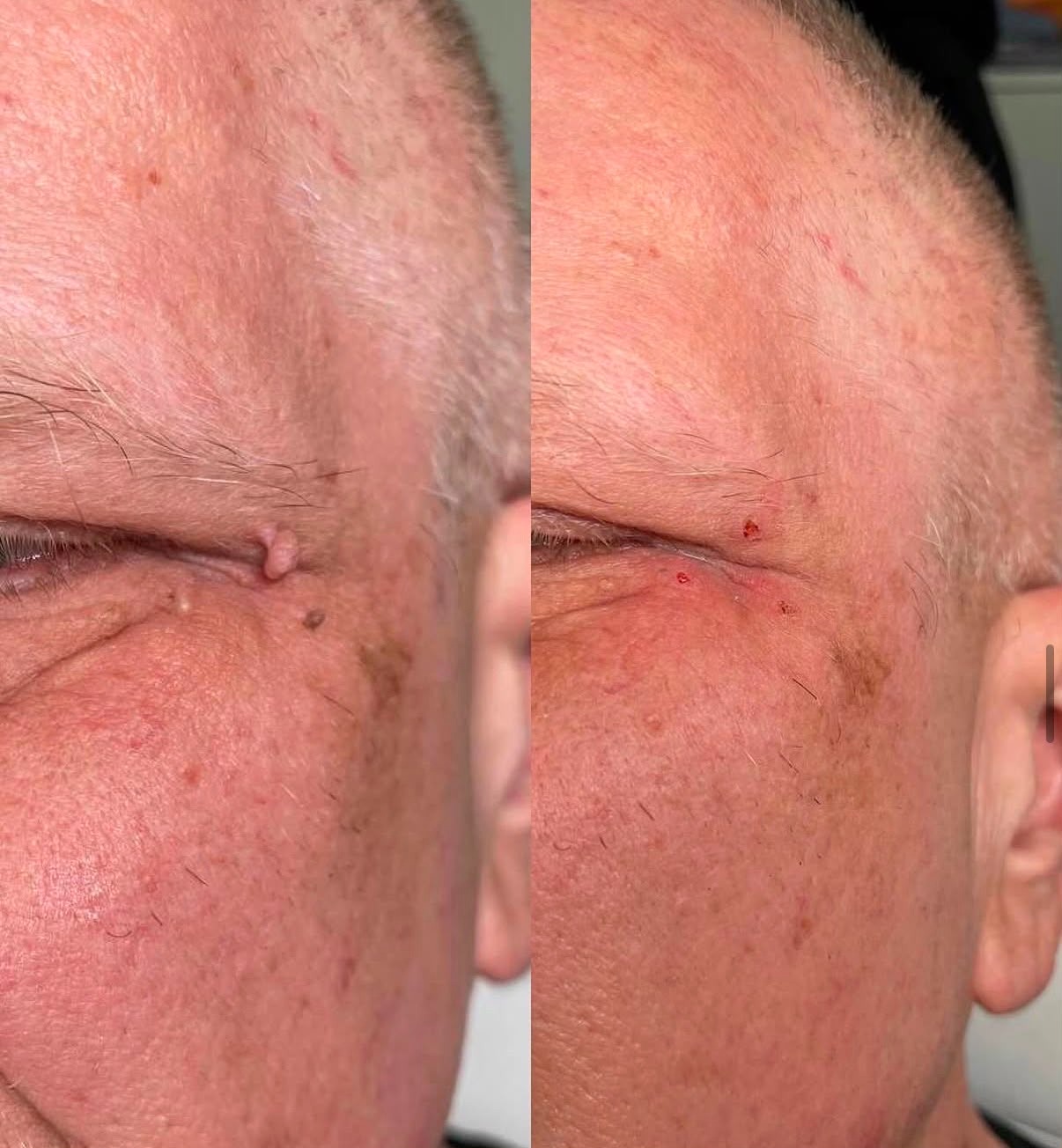
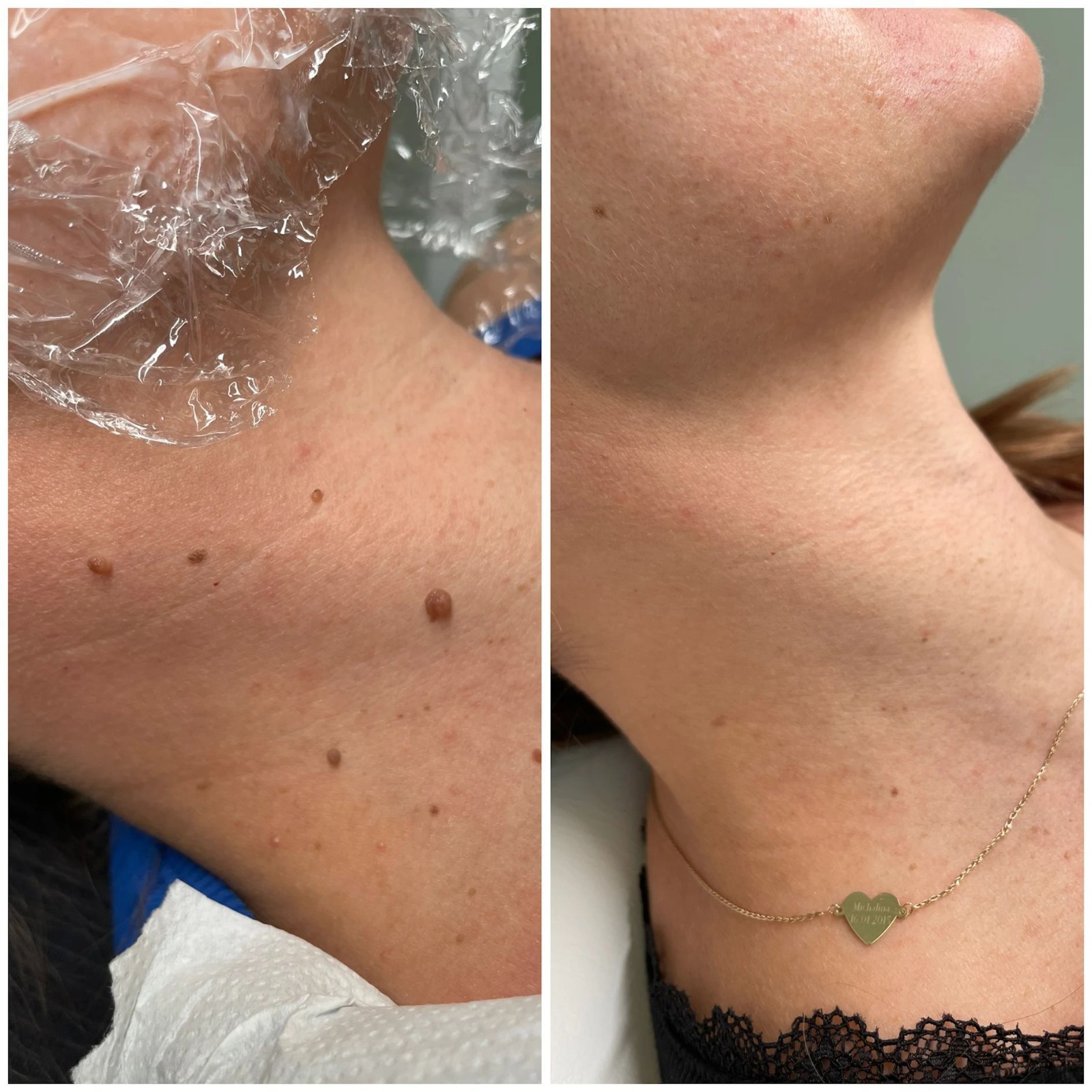
The fibroma is removed during the treatment; we assess the final appearance of the skin once it has fully healed. The result is individual and depends on the size and location of the lesion, the skin type and aftercare - we do not guarantee a specific result. When laser fibroma removal is performed correctly, the scar is minimal or invisible. In people prone to fibromas, new lesions may appear in other places over time. You can see example results in our results gallery.
Prices of laser fibroma removal in Wrocław - how much does it cost?
The price of laser fibroma removal depends on the size and number of lesions and their location. Below are approximate prices - the doctor gives the final quote after assessing the lesions during the consultation.
| Scope | Approximate price |
|---|---|
| Laser fibroma removal (one lesion) | from 300 PLN |
| Several small lesions during one visit | individual quote after consultation |
| Surgical removal of a lesion (for comparison) | from 600 PLN |
The full MM Clinic price list is available on a separate page. See also our other laser treatments in Wrocław, including laser scar treatment.
Practical information
| Information | Details |
|---|---|
| Treatment time | 5–20 minutes |
| Anaesthesia | Local |
| Price | from 300 PLN per lesion |
| Number of lesions | Several lesions in one visit |
| Follow-up visits | If needed |
| Return to activities | After full healing (2–4 weeks) |
Laser fibroma removal - frequently asked questions (FAQ)
The price starts from 300 PLN per lesion and depends on its size and location. We give the final quote during the consultation.
Yes. Benign soft fibromas (skin tags) respond very well to the fractional CO2 laser. A prior medical assessment of suitability is required - atypical lesions are referred for surgical excision with histopathological examination.
A fibroma is made up of connective (fibrous) tissue, whereas a mole is made up of pigment cells. They are two different types of benign lesions - they look different and have a different origin.
Thanks to local anaesthesia, the treatment is well tolerated. Small soft fibromas are removed very quickly, and patients usually feel only slight warmth.
Laser removal of benign lesions for aesthetic purposes is a private treatment and is usually not reimbursed by the NFZ (Polish National Health Fund). Lesions with a medical indication or a suspicion of cancer are assessed and removed surgically (with histopathology) - this is a separate pathway that you should ask your doctor about.
No. Pregnancy and breastfeeding are a contraindication - it is best to postpone the treatment. If the lesion is irritated or worrying, come for a consultation so that the doctor can assess whether it needs urgent attention.
Soft fibromas are benign and harmless. However, every lesion is assessed by a doctor - atypical or rapidly changing lesions are referred for surgical excision with histopathological examination.
The scab usually falls off after 7–14 days. Full skin regeneration takes 2–4 weeks.
A correctly removed fibroma usually does not grow back. However, people prone to these lesions may develop new fibromas in other places.
Usually several small lesions during one visit - the doctor determines the exact number after assessing their size and location.
Would you like to get rid of fibromas quickly and safely?
Book a consultation for laser fibroma removal in Wrocław - Michał Marciniak, MD will assess the lesions and choose a safe method.
Book a visit onlineor call: +48 731 731 335
Treatment performed by Michał Marciniak, MD
Sources
- Yumeen S, Khan T. Laser Carbon Dioxide Resurfacing. StatPearls [Internet]. StatPearls Publishing; updated 2023. PMID 32809379. ncbi.nlm.nih.gov/books/NBK560544
- Krupashankar DS. Standard guidelines of care: CO2 laser for removal of benign skin lesions and resurfacing. Indian J Dermatol Venereol Leprol. 2008;74(Suppl):61–67. PMID 18688106.
- Belgam Syed SY, Lipoff JB, Chatterjee K. Acrochordon. StatPearls [Internet]. StatPearls Publishing; updated 2023. PMID 28846244. ncbi.nlm.nih.gov/books/NBK448169
Article prepared by Michał Marciniak, MD. Last updated: September 2026.