Fractional laser in Wrocław
Treatments using the fractional laser
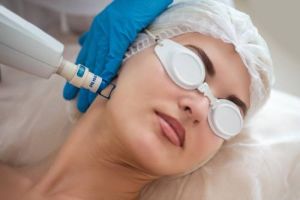
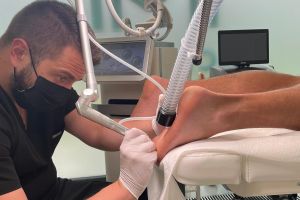
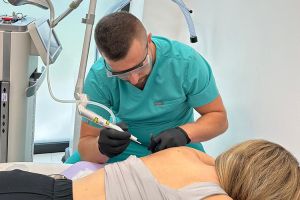
The fractional CO2 laser is one of the most versatile tools in modern aesthetic medicine - it can be used for skin rejuvenation, scars, stretch marks and the removal of benign skin lesions. At MM Clinic in Wrocław, CO2 laser treatments are performed by Michał Marciniak, MD, following an individual assessment. Below we explain how this technology works, what we treat with it and what you can realistically expect.
You can choose a specific treatment from the tiles above - there you will find details, the course of the procedure and prices for each indication.
How the fractional CO2 laser works
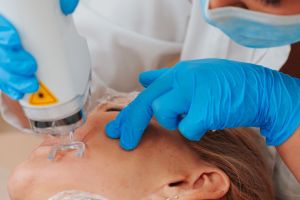
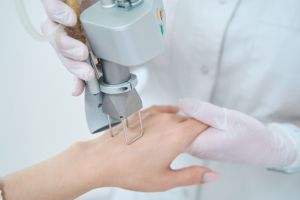
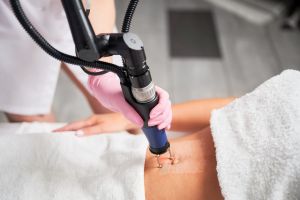
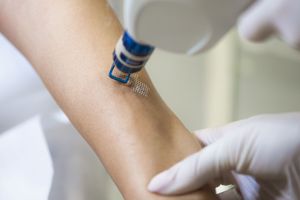
The CO2 laser emits light with a wavelength of 10,600 nm, which is strongly absorbed by the water contained in the skin [1]. In fractional mode, the energy is not delivered to the entire surface but into microscopic columns (thermal zones) surrounded by intact, healthy tissue - as a result, the skin heals faster and the risk of complications is lower than with “full-surface” lasers [1]. The controlled micro-injuries stimulate skin remodelling: tightening and the production of new collagen, which improves texture, firmness and skin tone [1].
What the treatment involves
Every treatment begins with a consultation, an assessment of the skin and the selection of laser parameters. We use local anaesthesia (a cream), and after the treatment the skin is cooled and protected. Microscopic healing zones form where the laser has worked - the epidermis usually regenerates within a few days to about a week, and temporary redness persists for up to about two weeks [1]. The exact course and recovery depend on the indication and the intensity of the treatment.
Results and number of treatments
The result depends on the indication. Some skin lesions are removed in a single treatment, whereas for rejuvenation, scars or stretch marks a course of 3–6 treatments is usually planned, and the improvement builds up as collagen remodels over the following weeks and months [1]. Results vary from person to person - we discuss realistic expectations at the consultation, without promising a guaranteed outcome.
Safety and contraindications
CO2 laser therapy is an established and generally safe method, but it involves possible temporary effects: redness, swelling, scabs and, less often, hyperpigmentation or hypopigmentation [1]. In people with darker skin the risk of hyperpigmentation is higher, which is why the parameters are chosen with particular care [1]. The most common contraindications include [1]:
- pregnancy and breastfeeding,
- an active skin infection at the treatment site (e.g. cold sores - antiviral cover may be needed),
- a tendency to form keloids,
- recent isotretinoin treatment (an interval is required, usually 6–12 months),
- a fresh tan and intense sun exposure,
- certain skin and systemic diseases - assessed individually.
Suspicious pigmented lesions are always assessed by a doctor first (dermoscopy) - they are never removed “by eye”. The final assessment of suitability for the treatment is made by a doctor.
Why MM Clinic
- Assessment and treatment by a doctor - skin assessment and parameter selection by Michał Marciniak, MD.
- An individual approach - parameters and the treatment plan tailored to the indication and skin type.
- Full information - realistic expectations, contraindications and aftercare instead of promises.
Frequently asked questions
It is a laser with a wavelength of 10,600 nm, absorbed by the water in the skin. It creates microscopic columns of controlled thermal damage surrounded by healthy tissue, which stimulates skin remodelling and collagen production and speeds up healing.
Among other things, signs of photoageing and wrinkles, scars (including acne scars), stretch marks and benign skin lesions such as warts, moles, naevi or fibromas. Always after a medical assessment.
It depends on the indication. Some lesions are removed in a single treatment, while for rejuvenation, scars or stretch marks a course of 3–6 treatments is usually planned. We agree on the plan individually.
It is an established and generally safe method when performed by qualified staff after a skin assessment. Temporary effects (redness, swelling, scabs) are possible, and in people with darker skin the parameters are chosen more cautiously because of the risk of hyperpigmentation.
Knowledge base - articles on laser therapy
Skin lesions:
Laser wart removal – how the CO2 laser works · Laser mole removal step by step · How much does mole removal cost in Wrocław · Skin tags (soft fibromas) – where they come from · Fibroma removal – laser or scalpel
Stretch marks:
Red and white stretch marks – the differences · Stretch marks after pregnancy · Do stretch mark creams work
Not sure which laser treatment is right for you? We will assess your skin and advise you.
Book a visit · tel. +48 731 731 335
Aesthetic medicine specialist. 10 years of experience, more than 8,000 botulinum toxin and dermal filler treatments. Member of the Polish Society of Aesthetic and Anti-Aging Medicine.
MM Clinic, ul. Strachowskiego 32, 52-210 Wrocław · tel. +48 731 731 335
Profile: znanylekarz.pl/michal-marciniak
Source
- Verma N, Yumeen S, Raggio BS. Ablative Laser Resurfacing. StatPearls [Internet]. StatPearls Publishing; updated 23.04.2023. ncbi.nlm.nih.gov/books/NBK557474