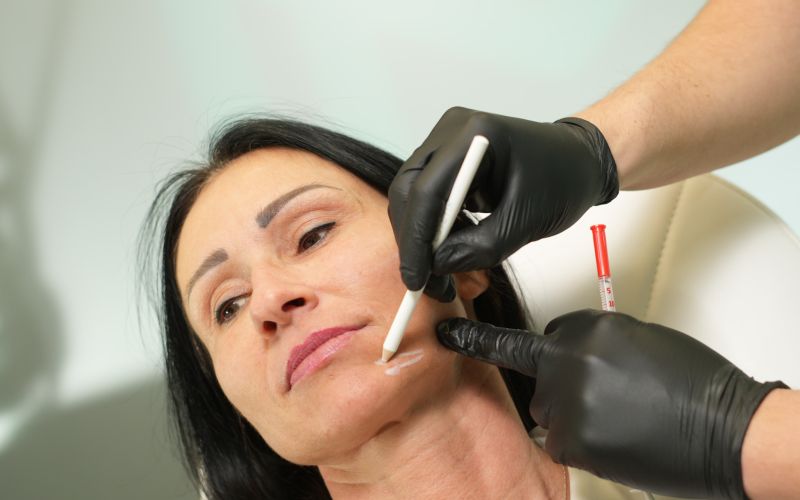
“Karisma or another treatment?” - this is one of the questions I hear most often during my consultations. The answer depends on your goal: rebuilding skin quality is one thing, and filling a wrinkle or hydrating the skin is another. In this article I explain, from a practitioner's perspective, how different categories of treatment work, how they differ and when a collagen biostimulator such as Karisma is a good choice.
Table of contents
- Why does this question come up at all?
- Biostimulator, filler, mesotherapy - what sets them apart?
- How does biostimulation work?
- When is it worth considering Karisma?
- When might another treatment be better?
- Can treatments be combined?
- What to look out for when choosing a treatment
- The most common myths about biostimulators
- The role of the consultation
- Safety and contraindications
- Summary
- About the author
- Sources
Why does this question come up at all?
The aesthetic medicine market is full of treatments with similar-sounding names, and patients often compare specific product brands instead of understanding how a given treatment works. Yet the most important question is not “which brand is better” but “what is my goal”. Only the goal determines whether the right tool is a biostimulator, a filler or mesotherapy. That is why, instead of comparing trade names, I will focus on categories.
Biostimulator, filler, mesotherapy - what sets them apart?
A biostimulator (such as Karisma in Wrocław) stimulates the skin to produce its own collagen and improves its overall quality, density and firmness. A filler primarily restores volume and smooths specific wrinkles or shapes selected areas of the face - the effect is visible immediately. Mesotherapy mainly hydrates and nourishes the skin with ingredients such as hyaluronic acid, vitamins or amino acids. These are three different goals which often complement rather than exclude one another.
You can compare it to looking after a house. A filler is like adding a missing element where volume has been lost. Mesotherapy is like good hydration and nourishment. A biostimulator is an investment in the foundations - it stimulates the skin to rebuild its structure itself.
How does biostimulation work?
With age, fibroblast activity declines and collagen fibres become fragmented, so the skin loses firmness and density [2]. Collagen biostimulators stimulate the biosynthesis of type I and type III collagen [3], and injectable recombinant collagen has a beneficial effect on the signs of photoageing [4]. This is precisely why we choose a biostimulator when the aim is to improve the condition and density of the skin - not to change the features or to achieve instant filling.
Collagen is the key word here. It is the main structural protein of the skin, responsible for its firmness, elasticity and thickness. When its production declines, the skin becomes lax and thinner. A biostimulator does not “paper over” this problem - it helps the skin return to rebuilding collagen on its own. That is why the effect can be longer-lasting than short-term hydration alone, although it requires patience and usually a course of treatments.
When is it worth considering Karisma?
In my experience, Karisma is a good choice when:
- the skin has lost firmness and density and looks tired and thinner;
- you want a natural effect without adding volume;
- you want to improve the quality of the skin on your neck, décolletage or hands;
- you are thinking about anti-ageing prevention and working “at the foundations”;
- you prefer an effect that develops gradually rather than instantly.
When might another treatment be better?
The honest answer is: Karisma is not the answer to everything. Another treatment may be more appropriate when:
- the goal is to fill a specific, deep wrinkle or to reshape an area - in that case we consider a filler;
- the skin mainly needs hydration and nourishment - mesotherapy can help;
- the problem is expression lines caused by muscle tension - we take a different approach;
- you expect an immediate effect for a specific occasion.
Can treatments be combined?
Yes - and this is often what gives the best effect. In practice, the plan is often staged: first we improve the quality and density of the skin with a biostimulator, and only then, if needed, do we restore volume. Guidelines and expert consensus statements emphasise that the choice of biostimulator should depend on the type and condition of the skin and on the patient's expectations [5]. You will find the full range of treatments on the page tissue biostimulators in Wrocław, and I have described the treatment itself in detail in the article Karisma - what the treatment is.
What to look out for when choosing a treatment
- your real goal - improving skin quality or restoring volume;
- assessment of suitability by a doctor and having the treatment performed in a doctor's treatment room;
- the time horizon - whether you want an immediate or a gradual effect;
- a long-term plan rather than a single treatment “for right now”.
The most common myths about biostimulators
A number of misconceptions have grown up around biostimulators, and they are worth clearing up before you make a decision:
- “A biostimulator is just a stronger filler.” No - it is a different category. A filler adds volume, whereas a biostimulator improves skin quality by stimulating collagen production.
- “I will see the effect straight away.” No. The effect of biostimulation develops over several weeks, because it comes from the work of the skin itself [3].
- “One treatment is enough.” A course is usually recommended - a single treatment gives a weaker and shorter-lasting result.
- “It will change my face.” Karisma does not reshape the features; it improves the condition and density of the skin, giving a natural effect.
The role of the consultation
The most important element of the whole process is a proper assessment of suitability. During the consultation I assess the type and condition of your skin, discuss your expectations and what the treatment can realistically achieve, and then propose a plan - sometimes this is Karisma alone, sometimes a combination of treatments spread over time. This conversation helps to avoid disappointment and to choose a solution that is genuinely tailored to you rather than to a passing trend.
Safety and contraindications
Each of the treatments discussed is performed after a medical assessment of suitability. Common contraindications include pregnancy and breastfeeding, active skin infections, autoimmune diseases during a flare-up and blood clotting disorders. The effect of every treatment is individual, which is why we always make the decision together during the consultation.
Summary
There is no single “best” treatment - there is the treatment best matched to your skin and your goal. If you would like to find out whether a collagen biostimulator such as Karisma is a good choice in your case, book a consultation at MM Clinic. You can read more about the treatment itself in the article Karisma - what the treatment is, and about its results in the article Karisma - results and longevity.
About the author
Michał Marciniak, MD - aesthetic medicine doctor, MM Clinic Wrocław, ul. Strachowskiego 32. ZnanyLekarz profile.
Sources
- [2] Varani J. et al. Decreased collagen production in chronologically aged skin. American Journal of Pathology, 2006.
- [3] Effect of poly-L-lactic acid and polydioxanone biostimulators on type I and III collagen biosynthesis. PMC, 2024.
- [4] Recombinant Type III Humanized Collagen Solution Injection in Improving Signs of Photoaging: a controlled clinical trial. PMC.
- [5] Optimizing Collagen Biostimulator Choice: Expert Consensus on Patient Selection. PMC.
How does a biostimulator differ from a filler?
A biostimulator (e.g. Karisma) stimulates the skin to produce its own collagen and improves its quality, whereas a filler primarily restores volume and smooths specific wrinkles.
Karisma or mesotherapy - which to choose?
Mesotherapy mainly hydrates and nourishes the skin, while Karisma additionally stimulates collagen production, improving density and firmness. The choice depends on the goal - which is determined by the doctor.
Can treatments be combined?
Yes, in many cases the treatments complement each other. The doctor determines the combination plan and the order of treatments during the consultation, depending on the needs of the skin.
Which biostimulator is the best?
There is no single best one for everyone. The choice depends on the type and condition of the skin and on your expectations - which is why an individual medical assessment of suitability is key.