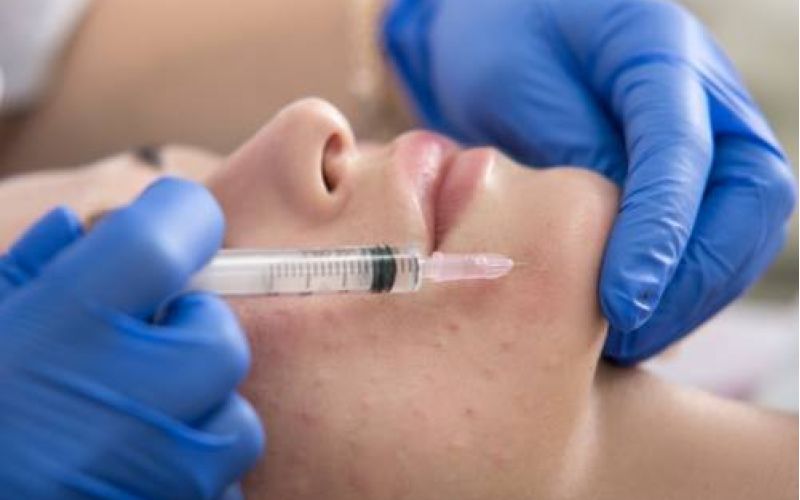
Patients often ask me whether “needle mesotherapy” and “microneedle mesotherapy” are the same treatment. They are two different techniques, although both involve puncturing the skin. In short: in needle mesotherapy what matters most is what we deliver into the skin, while in microneedle techniques it is how intensively we stimulate it. Below I explain the differences the way I explain them during a consultation, and suggest when each treatment makes sense.
Table of contents
Needle mesotherapy - precise nourishment of the skin
Needle mesotherapy (also called intradermotherapy) involves delivering an individually selected nourishing “cocktail” into the skin - most often to a depth of a few millimetres. Its composition may include, among others, hyaluronic acid, vitamins, amino acids, peptides and antioxidants, i.e. ingredients that support the proper function of fibroblasts, which are responsible for producing collagen [1]. The product is injected point by point with a fine needle, about 1 cm apart, with the composition tailored to the needs of the particular skin.
It is worth being honest from the outset: needle mesotherapy is a popular and biologically plausible treatment, but the quality of the scientific evidence is sometimes limited. Some studies and preclinical data point to a beneficial effect of multi-component formulations on skin condition [1], but there are also studies in which no significant histological changes or clear clinical improvement were found after a course of injections [2]. Reviews emphasise that, despite the method's many years of popularity, there is still a lack of large, well-designed controlled trials [3]. That is why I always approach the effect individually and do not promise guaranteed results.
Microneedle mesotherapy - stimulation through micro-punctures
In microneedle techniques (microneedling, also known as percutaneous collagen induction), the skin is punctured with many very short needles set in a handpiece or on a roller. This creates controlled micro-injuries that trigger the natural healing process: the body stimulates fibroblasts to migrate and produce collagen and elastin [4]. Clinical materials describe how a course of such treatments can significantly increase the deposition of collagen and elastin in the skin over several months [5].
Micro-punctures have one more property: they create temporary microchannels that increase the penetration of active substances deeper into the skin [4]. That is why microneedle techniques are sometimes combined with the delivery of products - and this is where, in practice, the line between “mesotherapy” and “microneedling” becomes blurred.
Needle or microneedle - the key differences
To simplify, the differences come down to the mechanism and the aim of the treatment:
- Method of delivery: needle mesotherapy consists of injections with a single needle, point by point; microneedle techniques involve multiple shallow punctures with a handpiece.
- Main mechanism: needle mesotherapy focuses on delivering nutrients; microneedling - on mechanically stimulating the skin to regenerate [4][5].
- Leading effect: needle mesotherapy is more often used for hydration and revitalisation, microneedling - to improve firmness and texture and to reduce scars [5].
- Combining: both methods can be used sequentially as part of a plan - the microchannels left by the punctures make it easier for products to penetrate [4].
There is no single “better” method here - there is a method better suited to the goal. If the skin is primarily dehydrated and tired, I usually suggest classic needle mesotherapy in Wrocław. When the goal is a more noticeable lifting and firming effect, I consider microneedle radiofrequency, which adds thermal energy to the punctures.
Safety and contraindications
Both techniques are considered well tolerated, but - like any treatment that breaks the continuity of the skin - they have contraindications. Typical ones include active infections and inflammation of the skin in the treatment area, active acne, a tendency to form keloids, reduced immunity, as well as pregnancy and breastfeeding. Materials on microneedling also list among the contraindications, among other things, the simultaneous use of certain treatments - which is why I always set the plan after taking a medical history and a medical assessment of suitability [5]. After the treatment, temporary redness and mild swelling are possible, which usually subside within 2–3 days [5].
Summary
Needle and microneedle mesotherapy are not synonyms but complementary tools. The first precisely nourishes the skin, the second stimulates it to regenerate and makes it easier for active ingredients to penetrate. Which method - or which combination of them - will be best in a given case is best decided after a consultation, during which I will assess the condition of your skin and your expectations. If you would like to compare the options, I invite you to a consultation at MM Clinic in Wrocław.
About the author
Michał Marciniak, MD - aesthetic medicine doctor with 10 years of experience. He performs treatments at MM Clinic in Wrocław, ul. Strachowskiego 32, 52-210 Wrocław. Contact: +48 731 731 335. Profile: ZnanyLekarz.
Sources
- Prikhnenko S. Polycomponent mesotherapy formulations for the treatment of skin aging and improvement of skin quality. Clin Cosmet Investig Dermatol. 2015. PMC4396578
- El-Domyati M et al. Efficacy of mesotherapy in facial rejuvenation: a histological and immunohistochemical evaluation. Int J Dermatol. 2012. PMID 22788806
- Konda D, Thappa DM. Mesotherapy: What is new? Indian J Dermatol Venereol Leprol. 2013. ijdvl.com
- Mayrovitz HN. Physiological Mechanisms and Therapeutic Applications of Microneedling: A Narrative Review. Cureus. 2025. doi:10.7759/cureus.80510
- Litchman G, Nair PA, Badri T, Kelly SE. Microneedling. StatPearls. 2022. NCBI Bookshelf NBK459344
How does needle mesotherapy differ from microneedle mesotherapy?
In needle mesotherapy, the product is injected with a single needle, point by point. In microneedle techniques, the skin is punctured with many short needles and the product penetrates through the resulting microchannels. Needle mesotherapy focuses on nourishment, microneedling - on stimulation.
Which method should you choose?
It depends on the goal. For dehydrated and tired skin, needle mesotherapy is more often the right choice; when lifting and improved firmness are needed - microneedle techniques, e.g. microneedle radiofrequency. The decision is made after a consultation.
Can needle and microneedle mesotherapy be combined?
Yes, both methods are sometimes used within a single plan - the microchannels left by the punctures make it easier for products to penetrate. The intervals and order are set by the doctor.
Are these treatments safe?
They are considered well tolerated, but they have contraindications (including skin infections, pregnancy and a tendency to form keloids). That is why a medical assessment of suitability is necessary every time.