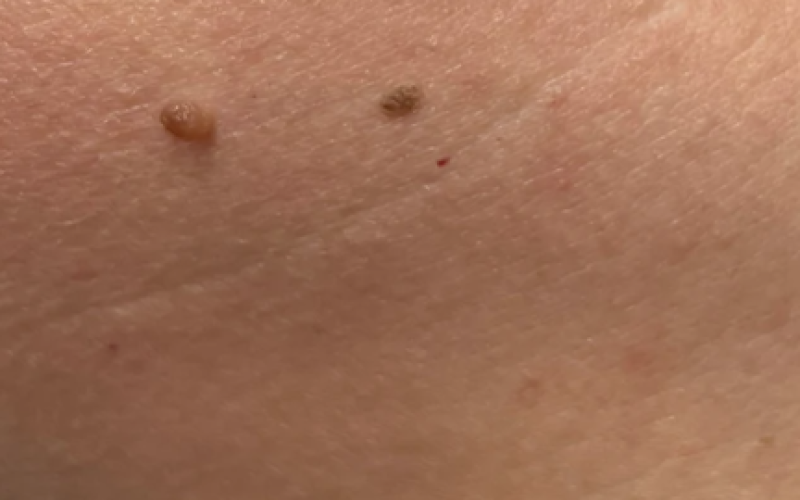
Soft fibroma is one of the most common benign skin lesions that patients come to me with - usually not because of pain, but because the lesion catches on clothing, jewelry or is simply annoying. In practice, the most common questions are: where did it come from and does it need to be removed? In short: it is a benign lesion that usually does not need to be removed for health reasons, but can be removed if it is troublesome or for aesthetic reasons. If you are looking for specific information about the procedure, I describe below what laser removal of skin tags in Wrocław looks like, as well as other methods and when the lesion should first be assessed by a doctor.
Contents
What is soft fibroma
Soft fibroma (Latin fibroma molle), also called acrochordon or colloquially "skin tag", is a benign growth composed of excess skin - loosely arranged collagen fibres with vessels, covered with the epidermis [1]. It is usually soft, pedunculated (set on a thin "leg") and is skin-colored or slightly darker. Larger, bag-like lesions of this type are called soft fibromas [1].
They are very common: it is estimated that approximately 50-60% of adults have at least one such lesion during their life, and the incidence increases after the age of 40 [1]. They most often appear in places exposed to friction and in skin folds - on the neck, eyelids, armpits and groin [1]. They are usually small (1-5 mm), less often they reach 1-2 cm. They do not hurt and are not tender, but they can be bothersome: they can get caught on clothes or chains, and with constant irritation, they can bleed or itch [1].
Where does soft fibroma come from (causes)
The exact mechanism of soft fibroma formation is still not fully understood [1]. However, it is known that they are favored by several factors, which in my practice most often occur together:
- natural skin ageing and loss of elasticity [1],
- friction - that's why the changes like skin folds and appear more often in overweight and obese people [1],
- hormonal factors - including: pregnancy (increase in estrogen and progesterone levels) and excess growth hormone in acromegaly [1],
- genetic predisposition and family occurrence [1].
Importantly, numerous soft fibromas may be a cutaneous "warning signal". Their presence is associated with metabolic disorders - obesity, type 2 diabetes, lipid disorders and insulin resistance [1]. Research indicates the role of insulin-like growth factor (IGF-1) in their formation [2]. Therefore, in the case of numerous or rapidly growing lesions, it is worth considering a basic metabolic assessment (e.g. glucose, lipid profile) - removing the lesion itself will improve the appearance, but will not address the possible systemic cause [1].
Does soft fibroma need to be removed
From a medical point of view, there is usually no need for this - soft fibromas are benign and have a very low or zero risk of cancer [1]. Removal is primarily considered when a change:
- aesthetically disturbing,
- is irritated and catches on clothes or jewelry, bleeds or itches [1],
- becomes curled on the pedicle, which may lead to inflammation and pain [1].
However, there is an important caveat: not every "growth" can be recognized by eye. Soft fibroma must be differentiated by, among others: with viral warts, moles, seborrheic warts, and less often with lesions requiring urgent diagnosis, such as melanoma nodules [1]. Therefore, an atypical lesion - rapidly growing, changing colour, bleeding for no apparent reason or with uneven edges - should first be assessed by a doctor. I describe more about similar changes in the entry about how laser wart removal works.
Methods for removing soft fibromas
Soft fibromas are removed using several proven techniques; the choice of method depends on the size, number and location of lesions and the doctor's decision [1]:
- Snip excision with surgical scissors - quick, good healing, with high patient satisfaction, especially in the case of pedunculated lesions [1].
- Radiosurgery / electrocoagulation - valued for its precision and ease of bleeding control [1].
- Cryotherapy (freezing) - with the risk of temporary discolouration of the surrounding skin [1].
- CO2 laser - precise tissue evaporation, used, among others, with smaller changes and in harder-to-reach places [1].
It is worth approaching the topic without simplifications: in a randomised study comparing cutting with scissors with a non-ablative 532 nm laser, this classic cutting resulted in better healing and higher satisfaction in pedunculated lesions - the authors emphasize that "laser is not always better", and in the case of small, disseminated lesions, further research is needed [3]. That's why I choose the method individually, not automatically. If you are wondering about the choice between evaporation and excision, I compare both methods in the entry removal of skin tags - laser or scalpel? The procedure is usually performed under local anaesthesia, and a small wound heals without major interventions [1].
Safety and contraindications
Removal of soft fibroma is a low-risk procedure performed in an office setting, but - like any procedure - it is not free from possible consequences [1]:
- bleeding during removal (sometimes requires pressure or coagulation),
- risk of scarring or discolouration if handled incorrectly,
- skin irritation at the treatment site, rarely infection,
- very rare neuroma with chronic discomfort if a nerve runs through the lesion [1].
Key rule: do not remove skin tags yourself at home. Without sterile conditions and proper technique, the risk of bleeding and infection increases [1]. The final qualification for the procedure - and the assessment of whether the lesion is truly benign - is always performed by a doctor.
Aftercare and prevention
- keep the wound clean and dry, follow care recommendations,
- don't scratch the scab; protect healing skin from the sun,
- reduce friction - avoid tight, synthetic clothing and jewelry that irritate the area [1],
- take care of general factors: proper body weight, activity and a healthy diet, which can be helpful in the case of the tendency to develop new lesions [1].
Remember that new skin tags may appear over time, especially with persistent risk factors - removing an existing lesion does not protect against the formation of new ones [1].
Summary
Soft fibroma is a common, benign skin lesion primarily associated with friction, age, hormones, and metabolic factors. It usually does not require removal for health reasons, but it can be removed when it bothers or irritates you - using several safe, individually selected methods. The most important thing: have any unusual changes assessed by a doctor first and do not remove them yourself at home.
Book a consultation at MM Clinic
We will assess the change and together we will select the appropriate method of proceeding.
Make an appointment
About the author
Michał Marciniak, MD - aesthetic medicine doctor.
10 years of experience, more than 8,000 botulinum toxin and dermal filler treatments performed. Member of the Polish Society of Aesthetic and Anti-ageing Medicine.
MM Clinic, ul. Strachowskiego 32, 52-210 Wrocław · tel. +48 731 731 335 · profile: znanylekarz.pl/michal-marciniak
Sources
- Pandey A, Saleh HM. Skin Tag (Acrochordon). StatPearls [Internet]. Treasure Island (FL): StatPearls Publishing; updated 13/12/2025. ncbi.nlm.nih.gov/books/NBK547724
- Farag AGA, Abdu Allah AMK, El-Rebey HS, et al. Role of insulin-like growth factor-1 in skin tags: a clinical, genetic and immunohistochemical study. Clin Cosmet Investig Dermatol. 2019;12:255-266. pubmed.ncbi.nlm.nih.gov/31118729
- Haase O, Winkelmann-Schirmer C, Mrowka P, Krengel S. Removal of skin tags: scissor excision versus non-ablative 532 nm-LBO-laser - a randomised controlled trial. Arch Dermatol Res. 2025;317(1):753. pubmed.ncbi.nlm.nih.gov/40347285
Is soft fibroma dangerous?
No. This is a benign lesion with a very low or zero risk of malignancy. Only unusual lesions should be of concern - rapidly growing, changing colour or bleeding - which require medical evaluation.
Will the skin tag go away on its own?
Usually no. If left, it may persist and, with constant friction, even increase in size. This does not mean removal is necessary - the decision is made individually.
Can skin tag be removed at home?
This is not recommended. Home "cutting" or tying may result in bleeding, infection and scarring, and you may miss a lesion that requires diagnostics. The procedure should be performed by a doctor.
Will the skin tag come back after removal?
The removed lesion usually does not grow back, but new ones may appear in other places, especially when favorable factors persist (friction, excess weight, metabolic disorders).
Does the procedure hurt?
Removal is usually performed under local anaesthesia, which makes it comfortable. After the treatment, there may be temporary irritation in the healing area.