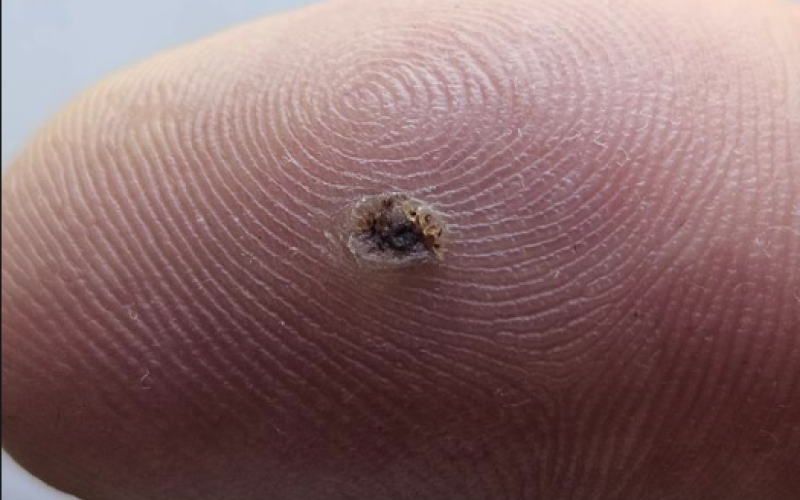
Warts, known medically as viral warts, are among the more common skin lesions that patients come to see me about - they can be persistent, painful (especially on the feet) and keep coming back despite home treatment. In my practice, when conservative methods fail, I turn to the CO2 laser, which precisely vaporises the wart tissue. If you are looking for information about the treatment, here is what laser wart removal in Wrocław looks like in practice - who it is suitable for, how it proceeds and what you can realistically expect from it.
Table of contents
What warts (viral warts) are
Warts are benign skin lesions caused by the human papillomavirus (HPV) [1]. More than 100 types of HPV have been described; common warts are most often caused by types 2 and 4, less often by types 1, 3, 27, 29 and 57, while plantar warts are caused mainly by type 1 [1]. Warts are estimated to affect around 10% of the population, and as many as 10–20% of school-age children, with a peak between the ages of 12 and 16 [1]. The infection is spread through direct or indirect contact (e.g. swimming pools, shared towels), especially when the epidermal barrier is damaged [1].
- common warts (verruca vulgaris) - most often on the hands and fingers,
- plantar warts - on the feet, they can be painful under pressure and when walking,
- flat warts - small and numerous, often on the face and the backs of the hands.
The diagnosis is usually made on the basis of a clinical examination; after the horny layer has been scraped off, small black dots are often visible - thrombosed capillaries that are characteristic of a wart [1].
How the CO2 laser works in wart removal (mechanism)
The CO2 laser emits light at a wavelength that is strongly absorbed by the water contained in tissues. Because warts have no selective “target” (chromophore) other than water, the CO2 laser is effective here - the energy is converted into heat, which vaporises (ablation) the wart tissue layer by layer while at the same time sealing small blood vessels [2][3]. This makes it possible to remove the lesion precisely with control over the depth, including in difficult areas such as the soles of the feet [3]. In scientific reviews, laser therapy of non-genital warts gives variable response rates - for the CO2 laser from around 50% to 100% [2].
Indications - who this treatment is for
In my practice I consider the CO2 laser mainly when:
- the warts are resistant to conservative treatment, e.g. salicylic acid or cryotherapy [1][2],
- the lesions are numerous, large or painful (e.g. plantar warts that make walking difficult) [1],
- the patient wants a quick, precise removal of a single lesion.
It is worth knowing that up to two thirds of warts resolve on their own within 12–24 months [1], which is why we make the decision about treatment individually. A lesion that raises diagnostic doubts (atypical appearance, rapid growth, change in colour) first requires a medical assessment - in such situations surgical excision with histopathological examination may be the appropriate option, because the laser vaporises the tissue and makes it impossible to assess it under a microscope. You will find more about the methods on the laser removal of skin lesions page.
How the treatment proceeds
- consultation and assessment of suitability - evaluation of the lesion, medical history, ruling out contraindications,
- local anaesthesia for the patient's comfort,
- vaporisation of the wart tissue with the laser beam - layer by layer, under visual control,
- treating a single lesion usually takes from a few minutes to a dozen or so minutes,
- dressing the wound and giving aftercare instructions.
Results and durability
In many cases a single treatment is enough to remove a single wart, although - as scientific reviews show - the response to treatment varies, and recurrences are possible with any method, because HPV may persist in the skin [1][2]. The result is individual and depends, among other things, on the type, location and number of lesions. That is why I do not promise a guaranteed result - instead, I discuss realistic expectations with the patient and a possible plan for further sessions.
Safety and contraindications
The CO2 laser is an established method, but like any ablative treatment it carries risks: post-treatment pain, temporary limitation of function in the treated area and scarring [2]. The most common contraindications, which we assess at the consultation, include:
- suspicion of a malignant lesion - this requires diagnosis, not a laser,
- active infection or inflammation at the treatment site,
- a tendency to form keloids,
- pregnancy - an individual decision, after a consultation,
- certain systemic diseases and taking photosensitising medicines.
The final assessment of suitability for the treatment is always carried out by a doctor.
Aftercare instructions
- keep the wound clean and dry; do not pick off the scab,
- use the recommended dressing or care product,
- avoid swimming pools, saunas and long baths until the area has healed,
- protect the healing skin from the sun (a cream with a high SPF),
- come for the follow-up visit as recommended; if you notice any worrying symptoms, contact the clinic.
Summary
Laser wart removal with a CO2 laser is a precise method for resistant, painful or bothersome lesions - but it is always preceded by a medical assessment of suitability and an honest conversation about the possible results. If you are struggling with a persistent wart, it is worth consulting a doctor about safe management.
Book a consultation at MM Clinic
Together we will assess the lesion and choose the appropriate method.
Book a visit
About the author
Michał Marciniak, MD - aesthetic medicine doctor.
10 years of experience, more than 8,000 botulinum toxin and dermal filler treatments performed. Member of the Polish Society of Aesthetic and Anti-Aging Medicine.
MM Clinic, ul. Strachowskiego 32, 52-210 Wrocław · tel. +48 731 731 335 · profile: znanylekarz.pl/michal-marciniak
Sources
- Al Aboud AM, Nigam PK. Wart. StatPearls [Internet]. Treasure Island (FL): StatPearls Publishing; updated 14.08.2023. ncbi.nlm.nih.gov/books/NBK431047
- Nguyen J, Korta DZ, Chapman LW, Kelly KM. Laser Treatment of Nongenital Verrucae: A Systematic Review. JAMA Dermatol. 2016;152(9):1025–1034. pubmed.ncbi.nlm.nih.gov/27119270
- Iranmanesh B, Khalili M, Zartab H, Amiri R, Aflatoonian M. Laser therapy in cutaneous and genital warts: A review article. Dermatol Ther. 2021;34(1):e14671. pubmed.ncbi.nlm.nih.gov/33314577
Does laser wart removal hurt?
The treatment is performed under local anaesthesia, which makes it comfortable. After the treatment, temporary pain or tenderness may occur in the healing area.
How many sessions are needed?
One session per single lesion is often enough, but the response varies, and with numerous or resistant warts a repeat treatment may be necessary. We agree on the plan individually.
Will there be a scar after the treatment?
There is a risk of scarring with any ablative method, but the precision of the CO2 laser makes it possible to limit it. Much depends on the location of the lesion and on individual healing.
Can warts come back?
Yes, recurrences are possible with any method, because HPV may persist in the skin. Looking after your immunity and hygiene reduces the risk.
Can every lesion be removed with a laser?
No. Lesions that raise diagnostic doubts first require a medical assessment and may need to be excised with histopathological examination.