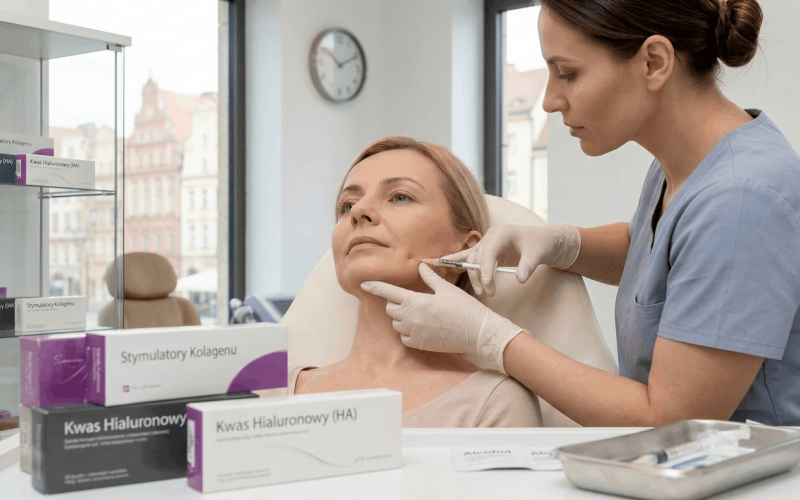
Fillers in aesthetic medicine are a broad and varied subject. Thanks to advances in medical science and technology, patients can choose from many types of products that can be tailored to their individual needs and expectations. In this article, we present popular types of fillers, new developments in the world of biostimulators and how these innovations can affect treatment results.
Table of contents
Popular fillers
Types
Fillers can be divided into several categories depending on their chemical composition and mechanism of action:
- Hyaluronic acid (HA) - the most commonly used filler, known for its moisturising properties and its ability to bind water. The effects are visible immediately after the treatment and last from 6 to 18 months.
- Calcium hydroxylapatite (CaHA) - used for deeper injections, it stimulates collagen production and provides natural-looking volume.
- Poly-L-lactic acid (PLLA) - known as Sculptra, it works as a biostimulator, stimulating collagen production, which leads to a gradual increase in volume in the treated area.
- Polynucleotides - work as biostimulators and improve skin hydration and elasticity.
- Botulinum toxin - although technically not a filler, it is used to reduce expression lines and to treat problems such as bruxism or excessive sweating.
| Filler type | Composition | Duration of effect |
| Hyaluronic acid | HA | 6-18 months |
| Calcium hydroxylapatite | CaHA | up to 2 years |
| Poly-L-lactic acid | PLLA | up to 2 years |
Uses
Fillers have a wide range of uses in aesthetic medicine:
- Wrinkle reduction - including marionette lines and smoker's lines.
- Facial contouring - contouring of the cheeks, chin and jawline.
- Volume restoration - filling sunken areas of the face.
- Skin revitalisation - improving hydration and elasticity.
MM Clinic expert tip: When choosing a filler, think about your needs and expectations. Also consider a consultation with an expert to choose the right product for your individual requirements.
An example of a biostimulator that improves skin quality and density rather than filling volume is the Karisma treatment.
New discoveries
Innovations
In recent years, new products have been introduced that aim to provide more natural-looking effects and longer-lasting action. One such innovative solution is Profhilo, which contains a high concentration of hyaluronic acid and is used to improve skin elasticity and hydration.
Other new developments include polynucleotide-based fillers, which stimulate skin regeneration and increase its density and elasticity.
Research
Clinical studies show that biostimulators such as PLLA and calcium hydroxylapatite not only improve the appearance of the skin, but also stimulate its natural regenerative processes. This means that the effects are not only immediate, but also long-lasting.
| Product | Type | Action | Duration of effect |
| Profhilo | HA | Hydration, elasticity | 6-12 months |
| Sculptra | PLLA | Collagen stimulation | up to 2 years |
| Radiesse | CaHA | Volume restoration, stimulation | up to 2 years |
When investing in new technologies, make sure they are backed by clinical research. At our clinic, we use only proven and safe methods.
Advantages and disadvantages of fillers
Each type of filler has its advantages and disadvantages, which are worth considering before deciding on a treatment.
| Product | Advantages | Disadvantages |
| Hyaluronic acid | Natural-looking effects, immediate results | Shorter duration |
| Calcium hydroxylapatite | Long-lasting effects, collagen stimulation | Possible lumps |
| Poly-L-lactic acid | Strong stimulation, long-lasting effects | Several sessions needed |
Treatment protocols
Each filler requires a different therapeutic approach, which affects the final result of the treatment.
| Product | Number of sessions | Interval between sessions | When effects appear |
| Hyaluronic acid | 1–2 | Every 6-12 months | Immediately |
| Sculptra | 3–4 | Every 4-6 weeks | After 3-6 months |
| Radiesse | 1–2 | Every 12-18 months | Immediately |
MM Clinic expert tip: We always recommend a consultation before the treatment in order to tailor the treatment protocol to the patient's individual needs.
Summary of key information
Fillers are an extremely versatile tool in aesthetic medicine, offering immediate and lasting effects. Modern biostimulators not only improve appearance, but also support the skin's natural regenerative processes.
What other sources won't tell you
- Red flags: Always check whether the clinic where you plan to have your treatment uses original, certified products.
- Myths vs facts: Not every effect can be achieved with a single type of filler. It is worth consulting an expert to choose the right therapy.
- Off-label: In some cases, fillers may be used outside their standard indications, but this requires a great deal of experience on the doctor's part.
FAQ
What are the before-and-after effects of tissue biostimulators?
The effects include improved skin elasticity and density, reduced wrinkles and an overall improvement in skin condition.
Which tissue biostimulator should you choose?
The choice of biostimulator depends on the patient's individual needs, indications and expected results.
Are there contraindications to tissue stimulators?
Yes, contraindications include pregnancy, breastfeeding, active skin infections and allergies to the ingredients of the product.
What do patients think of tissue biostimulators?
Most patients are satisfied with the natural-looking effects and the improvement in skin quality.
How do tissue biostimulators differ from hyaluronic acid?
Biostimulators stimulate natural regenerative processes, whereas hyaluronic acid works mainly as a filler.
Are tissue biostimulators effective after the age of 40 and 50?
Yes, they are particularly recommended for mature skin, where support for natural regenerative processes is needed.
We invite you to book a consultation at MM Clinic to find out which fillers and biostimulators will be best for your skin.
Contact us by phone or via the contact form on our website.