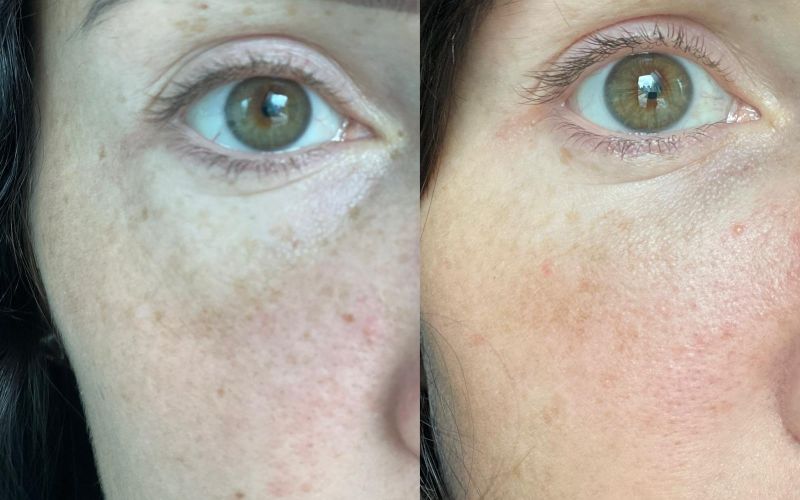
Short answer: Microneedle radiofrequency is not a painless treatment, but with proper anaesthesia the sensations are entirely acceptable - patients describe them as warmth and gentle scratching, not sharp pain. At MM Clinic in Wrocław we use local anaesthesia applied for 45-60 minutes, which brings discomfort down to a rating of 3-4/10. Importantly, unlike a fractional laser, treatments with the D-FRAX device can be performed safely all year round, including in summer.
Table of contents
- Afraid of needles? That is completely normal
- Does the treatment hurt? What is the anaesthesia really like?
- Microneedle radiofrequency in summer - why RF beats laser
- Side effects of microneedle radiofrequency - what is normal and what should worry you?
- Is the treatment safe for skin with dilated capillaries?
- Microneedle RF and rosacea - is it safe?
- FAQ - answers to the most common safety questions
- Does microneedle radiofrequency hurt?
- When should microneedle radiofrequency be done? Is summer possible?
- What are the side effects of microneedle radiofrequency?
- Can I function normally after the treatment?
- How long does one microneedle radiofrequency treatment take?
- Is the treatment safe during pregnancy?
- Summary - safety in the hands of professionals
Afraid of needles? That is completely normal
If you are reading this article, you are probably considering microneedle radiofrequency, but something is holding you back. Perhaps it is fear of pain. Perhaps uncertainty about whether the treatment is safe. Or perhaps you have heard that "it must not be done in summer" and are wondering whether that is true.
These concerns are completely understandable. The word "microneedles" sounds unsettling. The prospect of dozens of punctures on the face can cause anxiety even in people who have already had many aesthetic treatments.
At our clinic in Wrocław we talk every day with patients who have similar doubts. That is why in this article we will answer honestly all questions about pain, safety and possible side effects. No embellishment, no marketing slogans - just facts that will allow you to make an informed decision.
Does the treatment hurt? What is the anaesthesia really like?
The honest truth about the sensations
We will not claim that "you feel nothing" - that is not true and it would be dishonest. Microneedle radiofrequency is an invasive treatment in which needles penetrate the skin and thermal energy acts in its deep layers.
But - and this is crucial - the sensations are quite different from the ones you fear.
MM Clinic patients most often describe the sensations during the treatment as:
- "Warmth spreading under the skin" - pleasant or neutral, not burning
- "Gentle scratching" - as if someone were drawing on the skin with tiny needles
- "Vibration and tingling" - from the device at work
- "A hot stone feeling" - in areas treated with higher energy
It is definitely not "sharp pain" or "unbearable". Most patients chat calmly during the treatment, and some even fall asleep while the more comfortable areas are being treated.
How do we prepare you for the treatment at MM Clinic?
The key to a comfortable treatment is proper local anaesthesia. At our clinic in Wrocław we use a proven protocol:
45-60 minutes before the treatment we apply a thick layer of professional anaesthetic cream (containing lidocaine and/or prilocaine) to the entire treatment area. The cream is covered with occlusive film, which increases the penetration of the anaesthetic.
Effect: The skin surface is almost completely numbed. You feel the device working and warmth in the deeper layers - but no pain from the punctures.
Pain scale in different areas of the face and body
Not every area reacts in the same way. Here is what you can expect:
| Area | Discomfort level (1-10) | Description of sensations |
|---|---|---|
| Cheeks | 2-3 | The easiest area, minimal sensations |
| Forehead | 3-4 | Warmth, slight scratching |
| Eye area | 2-3 | Gentle parameters, very comfortable |
| Nose | 4-5 | More sensitive, short treatment time |
| Mouth area | 4-5 | More nerve endings |
| Neck | 4-5 | Thinner skin, greater sensitivity |
| Abdomen | 3-4 | Thicker skin, less sensitive |
| Stretch marks | 4-5 | Scar tissue may be more sensitive |
Tip from our clinic: If you have a low pain threshold, tell us before the treatment. We can extend the anaesthesia time, use additional comfort techniques or start with lower parameters and increase them gradually. At MM Clinic your comfort is a priority - we never "push through the pain" by force.
Microneedle radiofrequency in summer - why RF beats laser
MYTH: "Treatments cannot be done in summer"
This is one of the most common myths we hear from patients. And it does have a source - but it applies to fractional lasers, not to microneedle radiofrequency.
A fractional CO2 or erbium laser works in a completely different way: it emits a beam of light that damages the epidermis (the protective layer of the skin). After a laser treatment the skin lacks its natural barrier for 1-2 weeks, which makes it extremely sensitive to UV radiation. A laser treatment in summer is a recipe for pigmentation.
Why can D-FRAX be used all year round?
Microneedle radiofrequency works on a completely different principle:
The insulated needles of the D-FRAX device penetrate the skin and emit RF energy directly in the deep layers (the dermis). The epidermis is punctured at individual points, but it is not thermally damaged.
What does this mean in practice?
- No extensive damage to the protective layer
- The skin retains most of its natural barrier
- Healing is faster (2-5 days vs 7-14 days with a laser)
- The risk of sun-induced pigmentation is significantly lower
That is why treatments with the D-FRAX device can be performed safely in summer too - provided that the rules of sun protection are followed.
Safety rules for summer treatments
Although microneedle RF is safer in summer than a laser, certain rules apply:
- Mineral SPF 50+ - every day for at least 2 weeks after the treatment
- Avoiding direct sunbathing - for 3-4 weeks (no beach, no sunbeds)
- A hat and sunglasses - when spending longer periods in the sun
- Treatments before a holiday - at least 3 weeks before a trip to the seaside
Tip from our clinic: In summer we perform microneedle RF treatments just as often as in winter. Patients from Wrocław who work in offices and do not spend whole days in the sun can safely complete a full course between June and September. We discuss this individually during the consultation.
Side effects of microneedle radiofrequency - what is normal and what should worry you?
Normal post-treatment reactions
After a treatment with the D-FRAX device certain reactions always occur - a sign that the skin is regenerating and that collagen remodelling has been set in motion. Here is what is completely normal:
Immediately after the treatment (0-24h):
- Intense redness (as after a strong sunburn)
- A visible "grid" - marks from the needle punctures
- A feeling of warmth and tightness of the skin
- Mild swelling (especially around the eyes)
Days 1-3:
- Decreasing redness
- Dryness and a feeling of tightness
- Possible small scabs at the puncture sites
- Mild itching (a sign of healing)
Days 4-7:
- Redness visible only up close
- Fine peeling
- The skin gradually returns to normal
When to worry? Warning signs
Certain symptoms are not normal and require contacting the clinic:
- Increasing swelling after 48h - it should decrease, not increase
- Purulent discharge - may indicate an infection
- Fever - rare, but requires a consultation
- Blisters or small blisters - may indicate a burn (with incorrect parameters)
- Severe pain after 3 days - discomfort should be decreasing
At MM Clinic every patient receives our contact number and can get in touch with us if they have any doubts at all. It is better to call "unnecessarily" than to worry alone.
Why does the certified D-FRAX device minimise the risk?
The safety of the treatment depends on two factors: the quality of the equipment and the experience of the operator.
The D-FRAX device has medical certifications and built-in safety systems:
- Needle depth control with an accuracy of 0.1 mm
- Real-time monitoring of RF energy output
- Insulated needles protecting the epidermis from burns
- Automatic shutdown when an irregularity is detected
Combined with the experience of our team, this is a guarantee that the treatment will proceed safely, without undesirable complications.
Is the treatment safe for skin with dilated capillaries?
Good news: RF can help rather than harm
We hear this question very often, because people with dilated capillaries have had experiences with treatments that made their problem worse. Strong rubbing, hot compresses, aggressive peels - all of these dilate the capillaries.
Microneedle radiofrequency works differently.
RF energy delivered deep into the skin has a coagulating effect on small vessels. This means it can help close dilated capillaries rather than worsen them. Many patients with dilated capillaries notice less redness and less visible capillaries after a course of treatments.
Important caveats for skin with dilated capillaries
- Lower parameters - we use gentler settings
- Longer intervals between treatments - 6-8 weeks instead of the standard 4-6
- Avoiding areas with active inflammation - we do not work on "inflamed" skin
- A thorough consultation before the treatment - we assess each case individually
Tip from our clinic: If you have dilated capillaries, bring to the consultation a list of the treatments you have had before and how your skin reacted to them. This information will help us choose optimal parameters.
Microneedle RF and rosacea - is it safe?
Rosacea is a chronic inflammatory skin disease that requires particular caution with aesthetic treatments.
When is it YES to RF with rosacea?
- Remission phase - calm skin, without active inflammatory lesions
- Erythematotelangiectatic subtype - with dilated capillaries
- After a dermatological consultation - ideally with a certificate from a dermatologist
When is it NO to RF with rosacea?
- Active flare-up - papules, pustules, severe erythema
- Papulopustular subtype in the active phase
- No dermatological supervision - the skin needs treatment first
What can RF offer in controlled rosacea?
- Reduction of dilated vessels (coagulation effect)
- Thickening and strengthening of the skin (thin skin is a feature of rosacea)
- Improvement of the protective barrier
- Reduction of hypersensitivity over time
At MM Clinic we make the decision about treating patients with rosacea individually, often in cooperation with the patient's dermatologist.
FAQ - answers to the most common safety questions
Does microneedle radiofrequency hurt?
Answer: With proper anaesthesia - it does not hurt in the traditional sense. You feel warmth, scratching and vibration, but not sharp pain. At MM Clinic we use local anaesthesia applied for 45-60 minutes, thanks to which patients rate the discomfort at 3-4/10. The areas around the nose and mouth are the most sensitive - the sensations there are somewhat stronger, but short-lived. After the treatment the skin may be sensitive for a few hours, which is eased by cooling and gentle skincare.
When should microneedle radiofrequency be done? Is summer possible?
Answer: Yes, microneedle radiofrequency can be performed all year round, including in summer. Unlike a fractional laser, RF energy is delivered directly to the deep layers of the skin through insulated needles, which protect the epidermis. As a result, the skin is not as sensitised to the sun as after a laser. However, you must use SPF 50+ for at least 2 weeks and avoid deliberate sunbathing for 3-4 weeks after the treatment.
What are the side effects of microneedle radiofrequency?
Answer: Normal side effects are: redness (1-3 days), a visible grid of puncture marks (24-48h), mild swelling (1-2 days), dryness and fine peeling (3-7 days). All of this is a natural part of healing. Worrying symptoms that require contacting the clinic are: increasing swelling after 48h, purulent discharge, fever or blisters. When the treatment is performed correctly with certified D-FRAX equipment, complications are very rare.
Can I function normally after the treatment?
Answer: Yes, with minor restrictions. On the day of the treatment it is best to go home and rest - the skin is red and sensitive. The next day you can work remotely or do calm tasks. From day 2-3 you can go out wearing mineral make-up. Avoid intense physical exercise, saunas and swimming pools for 5-7 days. Most patients schedule the treatment for a Thursday or Friday so that they can use the weekend for recovery.
How long does one microneedle radiofrequency treatment take?
Answer: The treatment itself takes 20-45 minutes depending on the area treated - the face takes about 20-30 minutes, the face with the neck and décolletage about 40-45 minutes. On top of that comes the time for anaesthesia (45-60 minutes) and a short discussion of aftercare. The total visit time at MM Clinic is usually 90-120 minutes. It is worth setting this time aside without rushing.
Is the treatment safe during pregnancy?
Answer: No - microneedle radiofrequency is contraindicated during pregnancy and breastfeeding. This is a standard precautionary recommendation for most energy-based aesthetic treatments. There are no studies confirming safety for the foetus, so we recommend waiting until breastfeeding has ended. Many patients come back to us precisely after pregnancy to improve the quality of their skin and reduce any stretch marks.
Summary - safety in the hands of professionals
Microneedle radiofrequency with the D-FRAX device is a safe, well-tolerated treatment that can be performed all year round. The key to a comfortable experience is:
- Proper anaesthesia - 45-60 minutes before the treatment
- Certified equipment - D-FRAX with safety systems
- An experienced operator - who will adjust the parameters to your skin
- Reliable information - so that you know what to expect
At MM Clinic in Wrocław patient safety is the foundation of our work. We do not promise miracles and we do not hide facts. We speak honestly about the sensations, recovery and realistic results - because only on this basis can you make an informed decision.
Have more questions? Book a free consultation at MM Clinic in Wrocław. We will answer all your questions and assess whether microneedle radiofrequency is right for you.
Article prepared by the MM Clinic team - a safe aesthetic medicine clinic in Wrocław, where your comfort and safety are a priority.