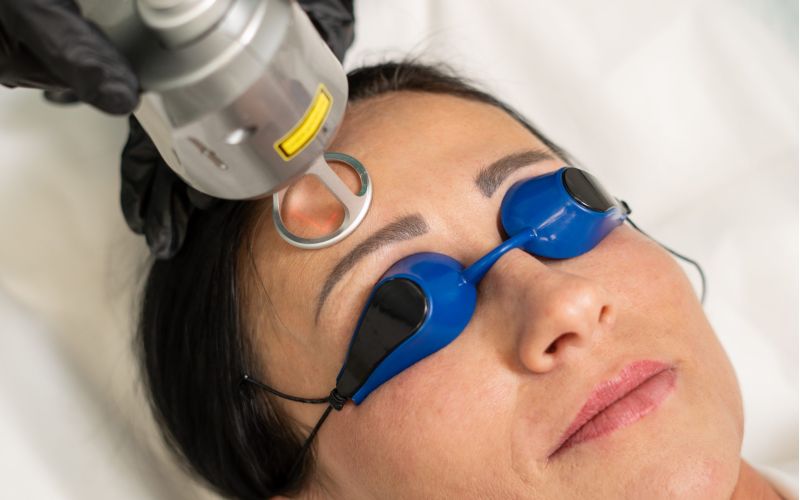
Wrinkles, pigmentation, dryness, loss of firmness and elasticity - these are the main signs of skin ageing, and they are most visible on the face. Although this process is a natural consequence of the passage of time, its effects can be limited in many ways. One of the most advanced non-surgical methods of facial rejuvenation is treatment with a fractional CO2 laser.
Table of contents
Why does skin age?
Skin ageing is a process influenced by external and internal factors. The first group includes, among others, ultraviolet radiation, tobacco smoke, the use of unsuitable skincare treatments, a poor diet and environmental pollution. The second consists of the properties of cells and metabolic processes, which change with age. The body's capacity for self-regulation gradually declines, and the skin begins to produce less collagen and elastin.
In each person, this process may begin at a different age and progress at a different pace. Its effects most often start to become visible between the ages of 25 and 30 [1]. Shallow wrinkles (less than 0.05 mm deep) appear on the face and deepen over time. As a result of the loss of lipids and water in the epidermis, the skin becomes dry. In turn, a smaller number of fibroblasts synthesise less collagen, which leads to a decline in firmness and elasticity. The essence of fractional CO2 laser treatments is to reverse these trends - controlled micro-injuries stimulate the skin to regenerate and to increase production of the substances responsible for a youthful appearance.
How does fractional facial rejuvenation work?
The fractional laser beams create microcolumns of injury that reach the deeper layers of the skin. The microscopic openings created in this way usually cover 20-25% of the treated area - the rest consists of the healthy epidermal cells surrounding them [2]. It is thanks to these cells that the natural process of healing and regeneration begins. As a result, collagen, the substance responsible for skin firmness, is produced.
This treatment is completely safe and simple - it is performed under local anaesthesia. It is not very painful, although the patient may feel slight discomfort. Modern devices allow doctors to adjust the laser parameters to the individual needs and skin type of each patient.
After the procedure, the patient does not require hospitalisation and can go home. Soon afterwards, redness and swelling appear on the face; the swelling should subside after 2-3 days. During this time the skin is dry, and itching or burning may also be felt. When the epidermis begins to peel, this means that the renewal process is under way. At this stage it is worth using gentle moisturising creams. The complete healing period lasts about 4-5 weeks.
What effects does fractional facial rejuvenation bring?
The effects of a fractional laser treatment (or course of treatments) appear gradually. This is due to the nature of the skin's natural regeneration process, which can take as long as several months. It is worth waiting, however, because skin remodelled in this way can retain a youthful, radiant appearance for as long as several years.
The most important effects of fractional facial rejuvenation include:
- smoothing of wrinkles and folds,
- increased skin elasticity as a result of increased production of collagen and elastin,
- reduction of pigmentation and a more even skin tone,
- less visible pores,
- brighter skin and improved skin texture,
- less visible scars.
The effectiveness of the fractional laser is confirmed by numerous studies. An analysis by Christiansen and Bjerring [4] showed that 3 months after therapy, an improvement in dermal density was found in as many as 72.7% of patients (assessed by ultrasound). 80% of participants reported satisfaction with the reduction of visible perioral wrinkles, and 62.5% reported an improvement in uneven skin tone.
Importantly, the fractional laser is also used as an integral part of treatment strategies involving other methods, including radiofrequency, microneedling and topical products.
—
Sources:
[1] Resich-Kozieł L., Niemyska K., 2020, Rodzaje oraz przyczyny starzenia się skóry, Kosmetologia Estetyczna, vol. 9
[2] Czarnota A., 2016, Pielęgnacja i regeneracja skóry po nieinwazyjnych zabiegach odmładzania twarzy, Kosmetologia Estetyczna, vol. 5
[3] Haykal D. et al., 2024, Advancements in laser technologies for skin rejuvenation: A comprehensive review of efficacy and safety, Journal of Cosmetic Dermatology, vol. 23
[4] Christiansen K., Bjerring P., 2008, Low density, non-ablative fractional CO2 laser rejuvenation, Lasers Surg Med.