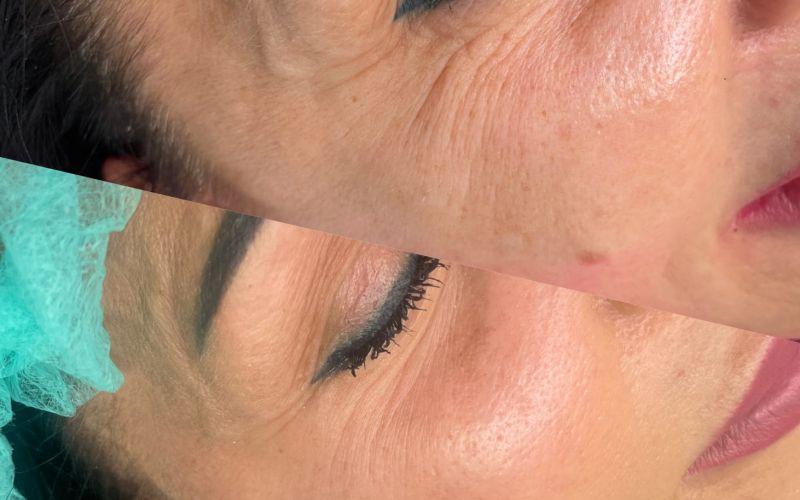
microneedling radiofrequency combines two skin stimulation mechanisms - needling (mechanical stimulus triggering regeneration) and radio wave energy (thermal stimulus causing contraction of collagen fibres). Fractional technology means that the damage is pinpoint - micro-columns are created surrounded by healthy tissue, which accelerates healing. The key to safety are insulated needles that emit energy only at the tip, protecting the epidermis from burns.
Contents
- Who is this article for?
- microneedling radiofrequency - what is it? Definition
- Mechanism of action: puncturing and heating synergy
- What is fractional technology in RF?
- Insulated vs non-insulated needles - key technology difference
- Penetration depth: why 0.5 mm under the eyes and 3.5 mm on the stomach?
- RF energy parameters - what do watts mean?
- Protein coagulation - the science behind the tightening effect
- FAQ - Answers to technical and practical questions
- Summary - technology in the service of effects
Who is this article for?
If you want to know not only what the treatment does to your skin, but also how and why - this text is for you.
Many articles about microneedling radiofrequency are limited to marketing slogans: "rejuvenates", "tightens", "stimulates collagen". That's true - but it doesn't explain anything. A conscious patient wants to understand the mechanism. He wants to know why one treatment works better than another and what's really going on beneath the skin's surface.
This article is a deep dive into technology - written in language that non-medically trained people can understand, but with scientific precision.
microneedling radiofrequency - what is it? Definition
Radiofrequency Microneedling (Radiofrequency Microneedling, RF Microneedling) is an advanced aesthetic procedure involving the introduction of sterile microneedles into the skin that emit electromagnetic energy in the radio wave range (1-2 MHz). This energy is converted into heat in the deep layers of the skin (dermis), causing controlled thermal damage and stimulating the production of new collagen.
Key difference compared to classic microneedling (Dermapen): in addition to the mechanical stimulus (puncture), a thermal stimulus (tissue heating) is added.
Mechanism of action: puncturing and heating synergy
First mechanism: puncture as a signal for repair
When the needle penetrates the skin, it creates a microscopic channel of damage. The body immediately interprets this as a wound - and triggers a regenerative cascade.
Simplified diagram:
- Damage → 2. Inflammatory response → 3. Influx of repair cells → 4. Production of new collagen → 5. Tissue remodeling
This is a mechanism that has been used in microneedling for decades. It works, but it has limitations - the stimulation is relatively superficial and the tightening effect is minimal.
Second mechanism: RF energy as material shrinkage
This is where radio frequency comes into play. The radio wave energy emitted by the needles is converted into heat in the deep layers of the skin. The temperature reaches 55-65°C - high enough to cause denaturation of collagen proteins.
What does this mean in practice? Collagen fibres contract and shorten under the influence of heat. This is an immediate tightening effect, visible after the first treatment.
Analogy: Think of a woolen sweater thrown into hot water. The wool fibres shrink and the sweater becomes smaller and denser. Collagen fibres in the skin behave similarly - under the influence of controlled heat, they shrink, thickening the skin structure.
Synergy effect: why is combination more effective?
Dermapen itself: puncture → new collagen after weeks → gradual improvement
RF microneedle: puncture + heat → immediate shrinkage AND new collagen → faster and stronger effect
Clinical studies confirm this difference. A meta-analysis published in the Journal of Cosmetic Dermatology (2021) showed that RF microneedling achieves 35-40% better results on skin laxity and scarring compared to microneedling alone for the same number of treatments.
What is fractional technology in RF?
What does the word "fractional" mean?
The term “fractional” (fractional in English) describes how energy is delivered to the skin. Instead of treating the entire surface uniformly (like an iron pressing fabric), the device creates pinpoint microcolumns of damage.
Imagine a sheet of paper. You can:
- Burn completely - the entire surface is damaged, healing takes a very long time
- Prick with pins at regular intervals - pinpoint lesions surrounded by intact tissue
Fractional technology works like the latter option. Each needle creates one "microcolumn" - a tiny vertical channel of damage surrounded on all sides by healthy skin.
Why does it speed up healing?
Healthy tissue around each microcolumn acts as a reservoir of repair cells. They migrate from the sides to the center of the damage, accelerating regeneration.
Healing times comparison:
- Ablative laser (surface damage to the entire skin): 10-14 days
- RF fractional microneedle (point microcolumns): 2-5 days
It is the fractional technology that allows you to return to normal life much faster after the RF microneedle treatment than after the laser.
Needle insertion density - a parameter that is not talked about
An important parameter is density of punctures per square centimeter. The D-Frax device allows you to adjust it:
- Lower density: fewer microcolumns, gentler treatment, faster healing
- Higher density: more microcolumns, more intense stimulation, longer recovery
An experienced operator adjusts the density to the problem. For delicate skin under the eyes - low density. For deep acne scars - high density for maximum reconstruction.
Insulated vs non-insulated needles - key technology difference
This is one of the most important technical aspects that directly affects the safety and effectiveness of the procedure.
Non-insulated needles - legacy
Older microneedle RF devices have metal needles throughout. RF energy is emitted through the entire surface of the needle - from the point of injection into the epidermis to the tip in the dermis.
Problem: The epidermis is also heated. This leads to:
- Higher risk of superficial burns
- Longer recovery
- Greater risk of discolouration (especially in darker phototypes)
- Seasonal restrictions (not recommended in summer)
Insulated needles - modern technology
The D-Frax device uses insulated needles - covered most of their length with a non-conductive material (silicone or gold coating). RF energy is emitted only from the uncovered tip of the needle, which is located in the deep layers of the skin.
Operating diagram:
Epidermis (insulation) → Dermis (insulation) → Needle tip (RF emission)Benefits of insulated needles:
- The epidermis is not heated - no risk of superficial burns
- Significantly lower risk of post-inflammatory hyperpigmentation
- Possibility of performing treatments all year round (also in summer)
- Safety for darker skin phototypes (III-VI)
- Shorter recovery
Why is this important?
For the patient, the difference between insulated and non-insulated needles translates into:
| Aspect | Non-insulated needles | Insulated needles (D-Frax) |
|---|---|---|
| Risk of skin burns | Moderate | Minimal |
| Summer treatments | Not recommended | Possible (with SPF) |
| Safe for dark skin | Limited | High |
| Recovery | 5-7 days | 2-5 days |
| Risk of discolouration | 10-15% | 2-5% |
Penetration depth: why 0.5 mm under the eyes and 3.5 mm on the stomach?
The anatomy of the skin determines the parameters
Skin is not uniform. Its thickness varies significantly depending on location:
- Eye area: 0.5-0.8 mm
- Cheeks: 1.5-2 mm
- Forehead: 1.2-1.8 mm
- Neck: 1-1.5 mm
- Abdomen: 2-4 mm
- Thighs/buttocks: 3-5 mm
Precise depth adjustment
The D-Frax device allows you to adjust the needle penetration depth in the range of 0.5-4 mm with an accuracy of 0.1 mm. The operator selects the appropriate depth for the area and problem being treated.
Principle: The tip of the needle (emitting RF) should be located in the reticular layer of the dermis - where collagen fibres are concentrated. Too shallow - no effect. Too deep - risk of damage to subcutaneous tissue.
Example settings:
| Area | Typical depth | Justification |
|---|---|---|
| Eye area | 0.5-1mm | The thinnest skin, maximum care |
| Cheeks | 1.5-2.5 mm | Standard facial skin |
| Jaw/chin | 2-3 mm | Thicker skin, need for lifting |
| Neck | 1-1.5 mm | Thin, sensitive skin |
| Décolletage | 1-2 mm | Moderate thickness |
| Abdomen | 2.5-3.5 mm | Thick skin, deep fibres |
| Stretch marks | 2-3.5 mm | Scar tissue in deep layers |
Why does precision matter?
A device without the ability to precisely adjust the depth is like a hammer instead of a scalpel. Effective collagen stimulation requires reaching the right layer - neither higher nor lower.
At MM Clinic in Wrocław, we use the D-Frax device, which offers one of the most accurate depth controls on the market. This translates into the safety and effectiveness of the procedure.
RF Energy Parameters - What do watts mean?
Power and effect
RF energy is measured in watts (W). Higher power = more heat in the tissue = stronger stimulation.
Typical power ranges:
- Low (5-15W): delicate treatments, eye area, sensitive skin
- Medium (15-30W):standard facial treatments
- High (30-50W): intensive body treatments, deep scars
Balance between effectiveness and safety
Higher power does not always mean better results. Too much energy can lead to:
- Excessive tissue damage
- Prolonged swelling and redness
- In extreme cases - deep layer burns
An experienced operator balances power with other parameters (depth, density, emission time) to achieve the optimal effect with maximum safety.
Protein coagulation - the science behind the tightening effect
What happens at the molecular level?
Collagen is a protein with a triple helix structure - three amino acid chains twisted around each other. This structure gives the fibres elasticity and strength.
When the temperature exceeds 55-60°C, the hydrogen bonds stabilizing the helix begin to break. The protein changes shape - it shrinks and compacts. This is a process called thermal denaturation.
Controlled vs Uncontrolled Damage
Key: Temperature must be precisely controlled.
- 55-65°C: optimal thermal window - denaturation without destruction
- >70°C: too high - risk of tissue necrosis
- <50°C: too low - no effect
The D-Frax device monitors parameters in real time, maintaining the temperature in the optimal range.
FAQ - Answers to technical and practical questions
microneedling radiofrequency - how does it work on the skin?
microneedling radiofrequency works in two ways. First of all - microneedles mechanically puncture the skin, creating thousands of microchannels and triggering the natural healing process. Secondly - the needles emit radio wave energy, which is transformed into heat (55-65°C) in the deep layers of the skin. This heat causes immediate contraction of collagen fibres (tightening effect) and stimulates fibroblasts to produce new, young collagen over the following weeks and months.
What is the difference between insulated and non-insulated needles?
Non-insulated needles are solid metal needles that emit RF energy along their entire length - from the surface of the skin to the tip. They also heat the epidermis, which increases the risk of burns and discolouration. Insulated needles (used in the D-Frax device) are covered with a non-conductive coating along most of their length - energy is emitted only from the tip, in the deep layers of the skin. Thanks to this, the epidermis is not heated, convalescence is shorter, and treatments can be performed safely all year round.
What does "fractional" mean in the name of the treatment?
"Fractional" means that the skin damage is local, not superficial. Instead of treating the entire skin uniformly (like an ablative laser), the device creates thousands of microscopic columns of damage surrounded by healthy tissue. This healthy tissue acts as a reservoir of repair cells, accelerating healing. Therefore, after fractional microneedle RF, recovery takes 2-5 days and after ablative laser 10-14 days.
How much does RF microneedling cost?
The price of the treatment depends on the area treated and the clinic. Approximate ranges are: face 800-1500 PLN, face + neck 1200-2000 PLN, face + neck + décolletage 1500-2500 PLN, belly 1000-2000 PLN. A series of 3-4 treatments is an investment of PLN 3,000-6,000 per face. The current price list of treatments at MM Clinic in Wrocław can be found on this website.
Does needle depth affect pain?
Yes, but not linearly. Deeper penetrations (>2.5 mm) may be felt more because the needles reach deeper layers with more nerve endings. However, with proper local anaesthesia, the difference is minimal. More than depth, the sensations are influenced by the RF energy power - higher watts mean more heat, which some patients feel more strongly. The parameters are always adjusted to individual sensitivity.
How many needles does the device head have?
Microneedle RF device heads typically contain 25-64 needles arranged in a regular grid. More needles means a larger surface treated with one pulse, but also a larger number of punctures at the same time. The D-Frax device offers various tips with a different number of needles, selected for the area and problem - smaller heads for precise work (eye area), larger ones for large areas (abdomen).
Summary - technology in the service of effects
microneedling radiofrequency is not magic - it is a precisely designed technology using basic principles of biology and physics:
- Pricking triggers natural regeneration
- RF energy shrinks collagen fibres and intensifies stimulation
- Fractionation accelerates healing
- Insulated needles protect the epidermis against damage
- Precise adjustment of depth and power allows you to adapt the treatment to each area
Understanding these mechanisms allows you to appreciate why microneedle RF produces better results on laxity and scarring than simpler methods - and why device quality and operator experience are critical to results.
Article prepared based on current knowledge in the field of biomedical engineering and aesthetic dermatology. The technology described in the article is available at MM Clinic in Wrocław.