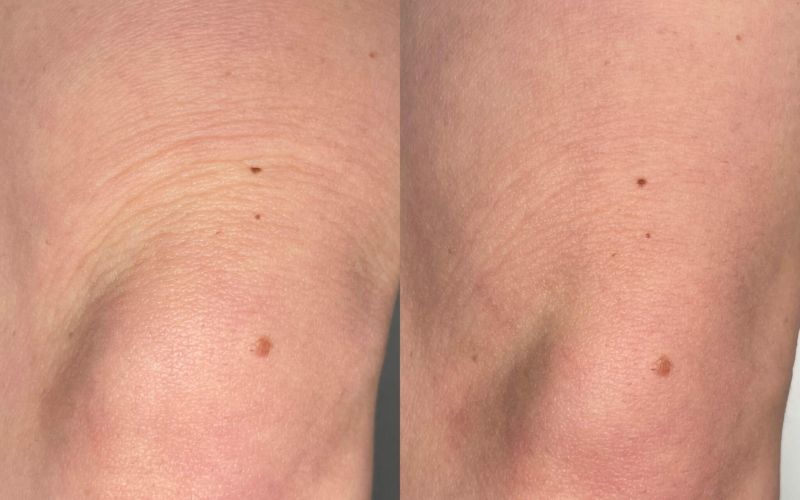
Dermapen (microneedle mesotherapy) is needling of the skin alone - mechanical stimulation. Microneedle radiofrequency with the D-Frax device is needling PLUS thermal energy, which additionally contracts the collagen fibres. The result? Microneedle RF gives stronger skin tightening and better results for skin laxity and scars. Dermapen works well for improving skin tone and shallow wrinkles. For laxity, deep scars and lifting, microneedle radiofrequency is more effective.
Table of contents
- So many treatment names - what should you actually choose?
- Fractional microneedle radiofrequency - what exactly is it?
- Microneedle radiofrequency or Dermapen - why does adding heat change everything?
- Which is better: Dermapen or microneedle radiofrequency? Comparison table
- Standard (needle-free) RF vs microneedle radiofrequency - aren't they the same?
- Microneedle radiofrequency vs HIFU - when to choose which?
- Will microneedle RF replace classic needle mesotherapy?
- Microneedle RF vs fractional laser - a brief comparison
- FAQ - frequently asked questions about comparing the technologies
- Which is better: Dermapen or microneedle radiofrequency?
- Does microneedle radiofrequency hurt more than Dermapen?
- How much does microneedle radiofrequency cost compared with Dermapen?
- Can I have microneedle RF in summer?
- Will microneedle RF replace a surgical facelift?
- Which treatment should I choose for acne scars?
- Summary - which treatment should you choose?
So many treatment names - what should you actually choose?
Dermapen, microneedle mesotherapy, radiofrequency, fractional RF, HIFU, fractional laser… Patients who come to our clinic in Wrocław are often lost in a maze of names. "Doctor, isn't it the same thing, just called something different?" - we hear this regularly.
No, it is not the same thing. And the difference between these treatments is not marketing - it is a fundamentally different mechanism of action, which translates into completely different effects.
In this article we explain the differences in plain language, without medical jargon. You will find out which treatment to choose depending on your problem - and why, for skin laxity and scars, microneedle radiofrequency is the solution that brings the best results.
Fractional microneedle radiofrequency - what exactly is it?
Before we move on to comparisons, let us explain precisely what microneedle radiofrequency is.
Technical definition: Fractional microneedle radiofrequency (Fractional RF Microneedling) is a treatment combining two mechanisms of skin stimulation - mechanical (needling with microneedles) and thermal (radio-wave energy at a frequency of 1-2 MHz). The needles penetrate the skin and emit RF energy directly in the deep layers, bypassing the epidermis.
The word "fractional" means that the treatment works point by point - it creates micro-columns of thermal injury surrounded by healthy tissue, which speeds up healing.
At MM Clinic we work with the D-Frax device, which allows precise control of the needle depth (0.5-4 mm) and the RF energy power - adjusting the parameters to the problem and the body area.
Microneedle radiofrequency or Dermapen - why does adding heat change everything?
Dermapen (microneedle mesotherapy) - how does it work?
Dermapen is a device with multiple microneedles that puncture the skin thousands of times during a single treatment. The controlled micro-injuries trigger the healing process - the skin produces new collagen to "patch up" the tiny holes.
It works - but only to a certain extent. Dermapen works very well for:
- Improving skin tone and radiance
- Reducing shallow wrinkles
- Absorption of active substances (mesotherapy)
- Evening out skin texture
D-Frax microneedle radiofrequency - why does it go a step further?
The D-Frax device also punctures the skin, but the needles emit thermal energy directly into the dermis. This energy heats the tissue to a temperature of 55-65°C.
And this is where the magic happens: the heat causes immediate contraction of the collagen fibres.
Imagine a woollen jumper thrown into hot water - it shrinks and becomes denser and more compact. Exactly the same thing happens to the collagen fibres in your skin under the influence of RF energy. Dermapen punctures but does not heat - so this "contraction" effect simply does not occur.
The practical difference in results
Dermapen = new collagen forms gradually over weeks (mechanical stimulation)
D-Frax microneedle RF = immediate tightening (contraction of existing fibres) + new collagen over the following months (dual stimulation)
That is why, for skin laxity, a sagging jawline and deep scars, microneedle radiofrequency gives clearly better results. Dermapen alone will not achieve this lifting effect.
Tip from our clinic: Dermapen is not "worse" - it is different. At MM Clinic we offer both treatments and match them to the problem. If you want to improve skin tone and hydration, Dermapen with mesotherapy is enough. If you are dealing with laxity or scars, we recommend microneedle radiofrequency.
Which is better: Dermapen or microneedle radiofrequency? Comparison table
| Criterion | Dermapen (microneedle mesotherapy) | D-Frax microneedle radiofrequency |
|---|---|---|
| Mechanism | Needling only (mechanical) | Needling + RF thermal energy |
| Tightening effect (lifting) | Minimal | Clear - fibre contraction |
| Effectiveness for laxity | Low | High |
| Effectiveness for scars | Moderate | High |
| Improvement in skin tone | Good | Good |
| Pain during the treatment | 2-4/10 | 3-5/10 |
| Recovery | 1-2 days | 2-5 days |
| Number of treatments in a course | 4-6 | 3-4 |
| Price per treatment | Lower | Higher |
| Best use | Skin tone, hydration, shallow wrinkles | Laxity, scars, lifting, deep wrinkles |
Standard (needle-free) RF vs microneedle radiofrequency - aren't they the same?
Another common question from our patients. No, they are definitely not the same.
Needle-free radiofrequency (classic RF):
- RF energy reaches the skin through an electrode placed on the surface
- It has to pass through the epidermis - some of the energy is dispersed
- The tightening effect is superficial and short-lived
- It requires many treatments (8-12) for noticeable effects
Microneedle radiofrequency (D-Frax):
- RF energy is delivered directly to the deep layers of the skin through the needles
- It bypasses the epidermis - 100% of the energy reaches where it is meant to work
- The tightening effect is deep and long-lasting
- It requires fewer treatments (3-4) for visible effects
An analogy: classic RF is like trying to heat a house from the outside - the heat has to pass through the walls and some of it is lost. Microneedle RF is like placing a radiator directly in the room - the effect is immediate and much stronger.
Microneedle radiofrequency vs HIFU - when to choose which?
HIFU (High-Intensity Focused Ultrasound) is another popular lifting technology. It works in a completely different way - it uses focused ultrasound that penetrates very deeply, down to the SMAS layer (4.5 mm), where surgical facelifts also work.
The difference in depth and mechanism
| Feature | HIFU | D-Frax microneedle RF |
|---|---|---|
| Depth of action | 1.5-4.5 mm (including the SMAS) | 0.5-4 mm (dermis) |
| Main effect | Volumetric lifting, raising of the tissues | Skin densification, improved texture |
| Effect on fatty tissue | It may reduce/dissolve it | No effect on fatty tissue |
| Ideal for | People with a good amount of subcutaneous tissue | Slim people with thin skin |
The key difference: safety for slim people
At aggressive settings, HIFU can dissolve fatty tissue. For people with a fuller face this can be an advantage. But for slim patients with little subcutaneous tissue on the face, it is a risk. Loss of volume can make the face look more tired and "hollow".
D-Frax microneedle radiofrequency does not carry this risk - it works on the dermis, not on fatty tissue. That is why at MM Clinic we often recommend it to slim patients who want tightening without losing volume.
Tip from our clinic: HIFU and microneedle RF are not mutually exclusive - they can be combined! HIFU for deep lifting of the tissues, RF for densifying the skin surface. This combination gives comprehensive rejuvenation effects. We discuss the details individually during the consultation.
Will microneedle RF replace classic needle mesotherapy?
The short answer: no - and it should not. These are treatments with different goals that complement each other very well.
Needle mesotherapy - what is it for?
Classic mesotherapy involves injecting active substances (hyaluronic acid, vitamins, amino acids, growth factors) directly into the skin. The aim: nourishment, hydration, radiance.
Mesotherapy has no tightening effect - it does not contract collagen fibres and does not lift. Instead, it delivers nutrients where they are needed.
Why combine them rather than treat them as competitors?
At our clinic in Wrocław we often use combined protocols:
- D-Frax microneedle radiofrequency - tightening, lifting, remodelling of the skin structure
- Mesotherapy (2-3 weeks later) - nourishment, hydration, support for regeneration
The result? The skin is at the same time firm, denser AND radiantly nourished. This is a synergistic approach - each treatment enhances the effect of the other.
Microneedle RF vs fractional laser - a brief comparison
A fractional laser (e.g. CO2, erbium) is another effective rejuvenation method. However, it has significant limitations compared with microneedle RF:
Fractional laser:
- Causes visible scabs and redness for 7-14 days
- Requires avoiding the sun for many weeks
- Not recommended in summer (high risk of pigmentation)
- May not be safe for darker skin phototypes
D-Frax microneedle RF:
- Recovery of 2-5 days, without visible scabs
- Can be performed all year round (also in summer, with appropriate protection)
- Safe for all skin phototypes
- A shorter break from social activities
For patients with an active professional and social life, microneedle RF is often the more practical choice - especially when they cannot afford a longer "downtime".
FAQ - frequently asked questions about comparing the technologies
Which is better: Dermapen or microneedle radiofrequency?
It depends on the problem. Dermapen is good for improving skin tone, hydration and shallow wrinkles - it works mechanically through needling. Microneedle radiofrequency is better for laxity, a sagging jawline and deep scars - it adds a thermal effect that contracts collagen fibres. If your main problem is a lack of skin firmness, microneedle radiofrequency will give clearer results.
Does microneedle radiofrequency hurt more than Dermapen?
The difference is small. Dermapen is usually 2-4/10 on the pain scale, microneedle RF 3-5/10 - with standard local anaesthesia. For most patients the additional sensation of warmth with RF is comfortable rather than painful. At MM Clinic we apply anaesthetic cream for 45-60 minutes before every treatment, which minimises discomfort.
How much does microneedle radiofrequency cost compared with Dermapen?
Microneedle radiofrequency is more expensive than Dermapen - usually 1.5-2x the price per single treatment. However, it requires fewer sessions in a course (3-4 vs 4-6), and the effects last longer. In the long term the total cost may be comparable, with better results for laxity and scars.
Can I have microneedle RF in summer?
Yes - unlike a fractional laser, microneedle radiofrequency can be performed all year round. However, strict sun protection (mineral SPF 50+) is required for at least 2 weeks after the treatment, and deliberate sunbathing should be avoided for 4-6 weeks. At MM Clinic we also perform treatments in the summer season, always with detailed aftercare instructions.
Will microneedle RF replace a surgical facelift?
It will not replace it, but it may postpone it by 5-10 years. Microneedle radiofrequency is ideal for people with early or moderate laxity who are not yet ready for surgery. With significant sagging and excess skin (e.g. jowls, deep folds), a surgical facelift remains the only effective solution. At MM Clinic we honestly assess whether RF will deliver the expected effects or whether it is better to consult a plastic surgeon.
Which treatment should I choose for acne scars?
Microneedle radiofrequency is the gold standard in the treatment of acne scars. RF energy breaks down scar tissue and stimulates the production of new collagen at the site of the scar. Dermapen also helps, but the effects are less pronounced with deep, depressed scars. In the case of very deep "ice-pick" scars, a combination of several methods may be needed - we discuss this individually during the consultation.
Summary - which treatment should you choose?
| Your main problem | Best option |
|---|---|
| Laxity, sagging jawline | D-Frax microneedle RF |
| Acne scars, stretch marks | D-Frax microneedle RF |
| Tired-looking skin tone, lack of glow | Dermapen + mesotherapy |
| Deep lifting (full face) | HIFU or RF + HIFU |
| Slim face, thin skin | D-Frax microneedle RF (safer than HIFU) |
| Quick improvement before an event | Mesotherapy (shortest downtime) |
Not sure which treatment to choose? Book a free consultation at MM Clinic in Wrocław. We will assess the condition of your skin, discuss your expectations and together choose the optimal strategy - perhaps a single treatment, perhaps a combined protocol. In aesthetic medicine there are no universal solutions - there is an individual approach to each patient.
Article prepared by the MM Clinic team in Wrocław - a clinic offering a full range of rejuvenation technologies, from mesotherapy to advanced microneedle radiofrequency.