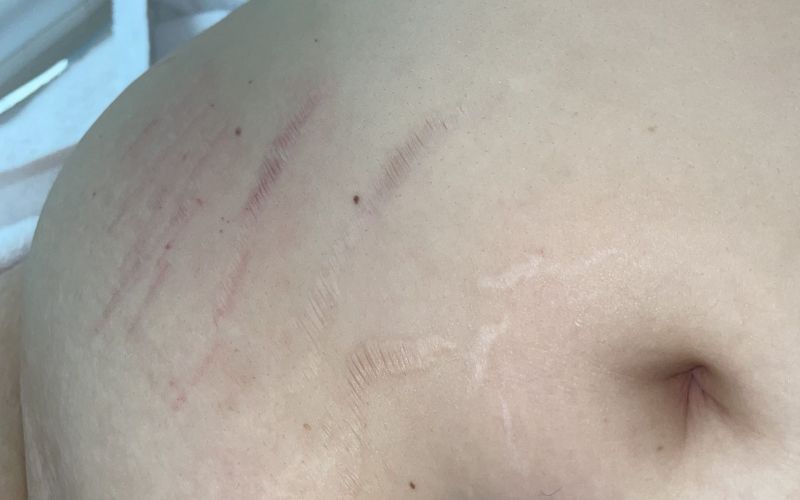
In theory, most scars and stretch marks have no medical consequences. For many patients, however, they are a serious aesthetic concern. Left untreated, these skin changes can have a negative impact on quality of life and even on the mental well-being of the people who have them. Fortunately, medicine offers many options for treating scars and stretch marks, and one of them is an injection of platelet-rich plasma (also known as PRP, short for Platelet-Rich Plasma). What does this treatment involve?
Contents
How does treatment of scars and stretch marks with PRP work?
Platelet-rich plasma is a product obtained by centrifuging the patient's own blood. This process concentrates the platelets, which contain growth factors. It is these growth factors that are released after the injection, leading to gradual skin regeneration and tissue renewal. This natural form of treatment is widely used in medicine, for example to speed up wound healing, reduce wrinkles or make scars and stretch marks less visible.
PRP treatment is preceded by a consultation, during which the doctor identifies the patient's needs, explains what the treatment involves and discusses contraindications to the therapy (these include, among others, autoimmune diseases, viral infections and inflammatory skin conditions, blood clotting disorders, cancer and pregnancy).
The treatment itself usually takes about 90 minutes and consists of several stages:
- drawing 10-20 ml of blood,
- centrifuging the plasma,
- appropriate preparation of the product,
- injection of the product.
The therapy is painless and does not require subsequent hospitalisation. Importantly, however, 3 to 5 treatments are usually needed, at intervals of at least one month. Because of the specific aim of the treatment - stimulating the skin to regenerate naturally and synthesise collagen - the results do not appear immediately. They are worth waiting for, however, because they last a very long time.
Platelet-rich plasma compared with other methods of treating scars and stretch marks
Stimulating the skin to regenerate itself is the main feature that distinguishes PRP therapy from other treatments for scars and stretch marks. Growth factors stimulate the production of collagen, hyaluronic acid and elastin - the components responsible for skin quality. It is worth remembering here that it is precisely damage to the collagen and elastin fibres of the dermis that leads to the formation of scars and stretch marks.
Compared with other methods of treating scars and stretch marks (chemical peels, laser therapy and fillers), platelet-rich plasma injections carry a low risk of adverse events and have fewer limitations, for example regarding the patient's skin type [2].
Results of treating scars and stretch marks with PRP
Therapy with platelet-rich plasma gradually makes scars (including acne scars) and stretch marks less visible. It also leads to a general improvement in the appearance and condition of the skin, seen, among other things, as:
- increased density and improved texture of the skin,
- improved elasticity and firmness,
- a more even skin tone (reduced pigmentation).
The effectiveness of PRP in treating skin lesions is confirmed by numerous studies. In 2012, a team of doctors from Seoul analysed the effect of platelet-rich plasma on the visibility of stretch marks [3]. In the study, PRP was administered in four sessions held every two weeks. Two months after the last treatment, 72.2% of patients rated the improvement as very satisfactory. The average width of the widest stretch marks decreased almost threefold - from 0.75 mm to 0.27 mm.
Researchers from Tehran University of Medical Sciences analysed studies on the effectiveness of treating scars with PRP [4]. The results were clear: it is an effective and safe method. Interestingly, adding platelet-rich plasma to other scar treatments markedly increased patients' satisfaction with the results. The improvement was rated as excellent by one in three people treated with an ablative laser and PRP, and by one in four patients treated with microneedling and PRP. When platelet-rich plasma was omitted, the proportion of people rating the results as excellent was 0% with laser alone and 3% with microneedling alone, respectively.
—
Sources:
[1] Faruga-Lewicka W., 2021, Wybrane terapie rozstępów wykorzystywane w gabinetach kosmetologicznych, Aesth Cosmetol Med.
[2] Shaimaa.A.E., Hanan.H.S., Shymaa.M.R., 2023, Platelet-Rich Plasma in Acne Scar: A Comprehensive Review, Benha Journal of Applied Sciences
[3] Suh D.H., Lee S.J., Lee J.H., Kim H.J., Shin M.K., Song K.Y., 2012, Treatment of striae distensae combined enhanced penetration platelet-rich plasma and ultrasound after plasma fractional radiofrequency, J Cosmet Laser Ther.
[4] Ebrahimi Z., Alimohamadi Y., Janani M., Hejazi P., Kamali M., Goodarzi A., 2022, Platelet-rich plasma in the treatment of scars, to suggest or not to suggest? A systematic review and meta-analysis, J Tissue Eng Regen Med.