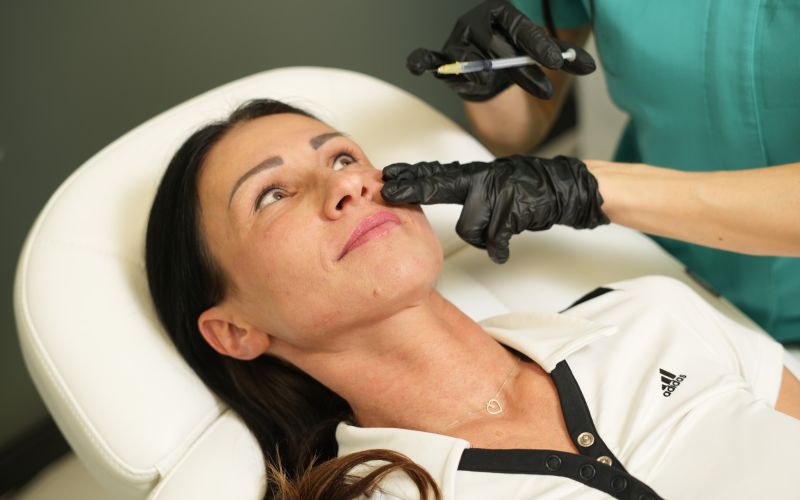
One of the properties of skin cells is their ability to regenerate. How long this process takes depends on many factors, including the type and extent of the damage. With age, the skin's capacity for natural renewal weakens. There are, however, ways to speed it up. One of them is an injection of platelet-rich plasma - a substance that helps both to reduce the signs of skin ageing and to regenerate the skin, e.g. after a burn or regeneration.
Table of contents
What is platelet-rich plasma?
Platelet-rich plasma (PRP) is a product obtained by centrifuging the patient's blood. This process separates out the platelets. It is the platelets that contain the growth factors which speed up skin regeneration and have a beneficial effect on fibroblasts (the cells that produce collagen). Obtaining PRP is very simple and quick - after 10-20 ml of the patient's blood has been drawn, it is spun for about 10-20 minutes in a special centrifuge. The platelet concentration in the platelet-rich plasma obtained in this way is 2-8 times higher than in blood [6].
The most commonly performed medical procedures using PRP include:
- lipofilling - filling folds and wrinkles with the patient's own fat tissue combined with platelet-rich plasma,
- mesotherapy of the facial skin and scalp,
- a mask intended to speed up healing after aesthetic treatments, peels and laser treatments.
Platelet-rich plasma in the renewal of ageing skin
Treatments using PRP have become popular above all as a way of rejuvenating facial skin - this is the so-called vampire facial (PRP facial), which well-known people are very keen to show off on social media. However, the great success of this procedure lies not only in its media potential but also in its real effects. Platelet-rich plasma improves skin firmness, has a beneficial effect on its quality and tone and reduces wrinkles. It is worth remembering that similar effects can also be achieved on other parts of the body, such as the neck, décolletage or hands.
The whole treatment - from the moment blood is drawn to the injection of PRP into the patient's skin - usually takes 1-1.5 hours. After a course of several treatments, the effects last for a dozen or so months.
Use of PRP in wound healing and skin regeneration
Apart from procedures aimed at rejuvenating the appearance of the skin, platelet-rich plasma is also used in many other areas. It is used, among other things, to treat scars and stretch marks, to renew the skin after liposuction, to speed up skin healing after burns, to treat ulcers, in androgenetic alopecia and to help post-operative wounds heal faster. PRP also has some unusual applications, e.g. as a way of increasing the survival of fat cells after a fat grafting procedure.
The regenerative functions of PRP are attributable to various types of growth factors, including:
- platelet-derived growth factor (PDGF) - has a very broad range of actions, including influencing the formation of epithelia and the proliferation of fibroblasts,
- transforming growth factors β (TGF-β) - contribute to the formation of the extracellular matrix (this group includes, among others, TGF-β1, which stimulates the healing of skin wounds),
- epidermal growth factors (EGF) - support the differentiation of epidermal cells, speed up wound healing and help to hydrate the skin,
- fibroblast growth factors (FGF) - promote wound healing, contribute to the growth of fibroblasts and stimulate them to produce collagenase,
- platelet factor 4 (PF-4) - influences the influx of neutrophils (a group of white blood cells that protect against infection) into injured tissue,
- human platelet-derived endothelial growth factor (PDEGF) - supports the proliferation of keratinocytes (the basic cells of the epidermis) and fibroblasts (cells found in the dermis).
Effective skin regeneration confirmed by research
The scientific literature provides many examples confirming the effectiveness of platelet-rich plasma in skin regeneration. In 2016, researchers from Iran carried out an interesting study in this area. They compared wound healing after caesarean section with and without the use of PRP [3]. In the first group, a greater reduction in redness, swelling, ecchymoses and discharge was observed than in the control group. Numerous studies have also shown that platelet-rich plasma alleviates chronic inflammation, thereby preventing further tissue damage [4].
The use of PRP reduces the visibility of acne scars, as confirmed by, among others, a study by doctors in India [5]. In a group of 50 patients they performed three treatments at monthly intervals, with the right side of the face treated with platelet-rich plasma and the left side with distilled water. The area where PRP was applied showed an improvement of 62.20 per cent. On the opposite side, this figure was 45.84 per cent. In the patients' subjective opinion, treatment with platelet-rich plasma produced clearly better results.
You can read more about skin regeneration treatments using PRP here: platelet-rich plasma.
—
Sources:
[1] Kurek M., 2012, Platelet-rich plasma and the skin ageing process, Puls Uczelni
[2] Piszczorowicz Ł., Król D., Dyląg S., 2020, Autologous platelet-rich plasma (PRP) therapy - a promising method of regenerative treatment of damaged tissues used in many fields of medicine, Journal of Transfusion Medicine
[3] Tehranian A. et al., 2016, Application of autologous platelet-rich plasma (PRP) on wound healing after caesarean section in high-risk patients, Iran Red Crescent Med J
[4] Ochyra Ł., Łopuszyńska A., 2024, Platelet-rich plasma in dermatology and aesthetic medicine, Quality in Sport
[5] Asif M., Kanodia S., Singh K., 2016, Combined Autologous Platelet-rich Plasma with Microneedling Verses Microneedling with Distilled Water in the Treatment of Atrophic Acne Scars: A Concurrent Split-face Study. J. Cosmet. Dermatol.
[6] Przylipiak A. (ed.), 2014, Fundamentals of Aesthetic Medicine. A textbook for cosmetology students