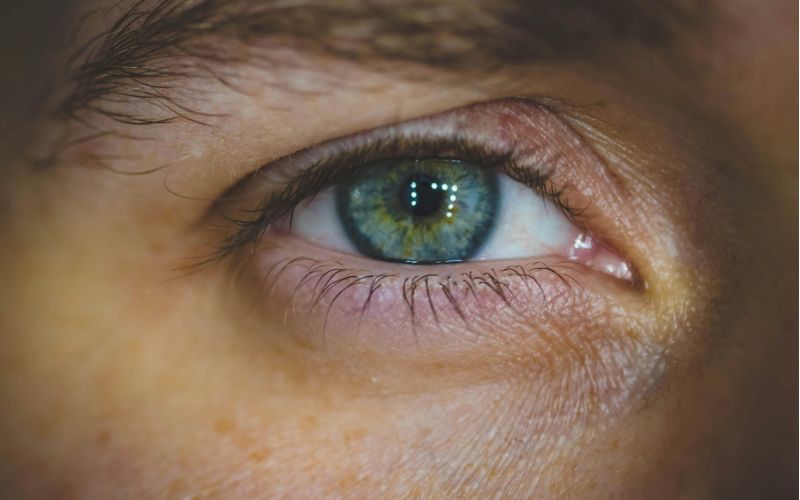
A drooping eyelid is a relatively common condition. Depending on the study and the region, it affects between 4.7% and 13.5% of adults, with a much higher proportion among patients over 80 years of age - 42.9% [1]. The treatment of a drooping eyelid depends mainly on its causes and on individual factors. What options are available? Is a drooping eyelid dangerous to health? Here is a list of the most frequently asked questions!
Table of contents
- What does a drooping eyelid look like?
- What causes a drooping eyelid?
- Is a drooping eyelid dangerous to health?
- How can a drooping eyelid be corrected?
- How can drooping eyelids be lifted without surgery?
- Does botulinum toxin lift the eyelid?
- How does microneedle radiofrequency help treat a drooping eyelid?
- How should you prepare for a drooping eyelid treatment?
What does a drooping eyelid look like?
A drooping eyelid (also called ptosis) is the medical term for an eyelid margin that sits too low. The free margin lies approx. 1-2 mm lower in relation to the upper edge of the corneal limbus, which can lead to the pupil being covered. In three out of four cases, only one eyelid droops.
Drooping eyelids are also a result of the natural ageing process of the skin - which is why the proportion of people with this condition increases with age. When both eyelids are affected, the face looks sad and tired. In this case, patients opt for treatment for purely aesthetic reasons.
What causes a drooping eyelid?
The origin of a drooping eyelid varies. In many cases it is a congenital condition that becomes apparent before the patient's first birthday. Ptosis can also be acquired as a result of oculomotor nerve palsy, a disorder of the levator palpebrae superioris muscle (the muscle that lifts the upper eyelid), autoimmune diseases, disorders of the neuromuscular junction, mechanical injuries and growths within the eyelid, such as cysts.
When eyelids droop as a result of ageing, the main causes are muscle weakness (in this particular case, of the levator palpebrae superioris muscle) and the loss of skin firmness and elasticity.
Is a drooping eyelid dangerous to health?
Contrary to appearances, a drooping eyelid is not just an aesthetic problem. It is often also the cause of functional impairment. The most frequently mentioned are a restricted field of vision and reduced visual acuity. Because of these issues and a lower sense of one's own attractiveness, ptosis can also have serious psychological consequences. Patients sometimes also report neck pain and tension headaches caused by compensating for the drooping eyelid, e.g. by having to hold the head in an unnatural position or raise the eyebrows on a regular basis.
How can a drooping eyelid be corrected?
The decision on how to treat the eyelid is made by the doctor after diagnosing the condition and its causes. Surgical methods are used most often. Differential diagnosis is of great importance in choosing one of them, as it confirms whether the problem is a neurological disease or a primary pathology of the eyelid retractor muscles. Before starting treatment, the doctor checks whether the function of the levator muscle has been preserved. There are also non-surgical methods of lifting the eyelid, e.g. using botulinum toxin or high-frequency radio waves.
How can drooping eyelids be lifted without surgery?
If drooping eyelids do not require a surgical procedure, e.g. when they are the result of the natural ageing process of the skin, the doctor may suggest other ways of lifting them. The most popular include botulinum toxin and microneedle radiofrequency. It is worth remembering, however, that the choice of treatment method is made by the doctor after first diagnosing the causes of the drooping eyelid.
Does botulinum toxin lift the eyelid?
An injection of botulinum toxin blocks the release of acetylcholine, which weakens or paralyses the muscles. For this reason, it is used when the drooping eyelid is caused by a muscle spasm around the eye. In addition to lifting the eyelid, botulinum toxin also helps to reduce wrinkles. The treatment takes from a dozen or so minutes to half an hour. A botulinum toxin injection is almost painless, so no anaesthesia is needed. You can find details here: botulinum toxin - Wrocław.
How does microneedle radiofrequency help treat a drooping eyelid?
Microneedle radiofrequency is a treatment that involves precisely puncturing the skin with fine needles and emitting radio waves, whose task is to heat the tissues. This process stimulates the skin to regenerate and produce new collagen fibres, making the skin more elastic, firm and taut. Apart from lifting the eyelid, microneedle radiofrequency brings many other benefits, e.g. it smooths fine wrinkles and improves skin tone. The best results are achieved with a course of several treatments at intervals of approx. 4 weeks. You can find more information here: microneedle radiofrequency in Wrocław.
How should you prepare for a drooping eyelid treatment?
How to prepare for the treatment depends on the treatment method. In the case of botulinum toxin, the patient should not take painkillers or anticoagulants, and should also refrain from drinking alcohol for at least a few days before the injection. Before microneedle radiofrequency, you should additionally avoid tanning beds and sun exposure. Most importantly, however, follow all of the doctor's recommendations and instructions - both before and after the treatment.
—
Sources:
[1] Jacuński M., Białas D., Różycki R., Ptoza – opadnięcie powieki górnej. Diagnostyka i leczenie [Ptosis - drooping of the upper eyelid. Diagnosis and treatment], Chirurgia i Laseroterapia
[2] Wiszniewska M., Rogoziewicz M., 2013, Opadanie powiek w chorobach neurologicznych [Drooping eyelids in neurological diseases], Polski Przegląd Neurologiczny
[3] Przylipiak A. (ed.), 2014, Podstawy Medycyny Estetycznej. Podręcznik dla studentów kosmetologii [Fundamentals of Aesthetic Medicine. A textbook for cosmetology students]