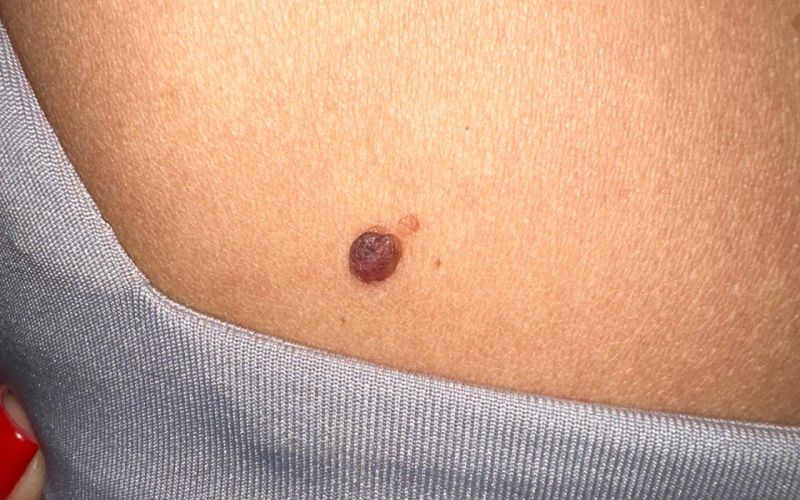
Moles, also called naevi or skin spots, are small, usually flat or raised clusters of melanocytes — cells that produce the pigment melanin. In their normal, healthy form they are benign pigmented moles that pose no threat to our health. Some people have moles from birth, but most moles develop under the influence of ultraviolet radiation on the skin. Some naevi may also result from viral infections, while others have a genetic basis. They are found on the skin of almost every person in the world.
But have you ever considered that moles can be dangerous? If they are not checked and observed regularly, there is a risk that dangerous changes will not be detected early. Some moles can evolve into dangerous skin lesions, such as melanoma, which is an aggressive type of skin cancer. That is why it is important to check your moles regularly for any changes in shape, colour, size or asymmetry. If an examination rules out a malignant lesion, benign moles can be removed quickly and without stitches — see laser mole removal in Wrocław.
Table of contents
Types of moles
Moles, formally called pigmented naevi, are divided into many types. Each of them has its own distinctive features:
Congenital naevus — present from birth or appears shortly after birth.
Becker's naevus — occurs mainly in men and often develops during puberty.
Sutton's naevus — surrounded by an area of lighter skin, which may suggest an autoimmune process destroying the mole cells.
Spitz naevus — a raised, pink mole, most often found in people with a fair complexion.
Blue naevus — dark blue or black and found mainly on the hands, feet or face.
Miescher's naevus (melanocytic naevus) — a smooth hyperpigmented naevus, usually brown in colour, which does not stand out from the surface of the skin.
Clustered naevi — groups of similar moles located in the same area of the body.
How to observe moles? What to look out for
When observing moles, there are several important factors worth paying attention to.
- First and foremost, it is important to monitor changes in shape, colour and size, as well as any bleeding or crusting. Pay attention to moles that seem unusual, asymmetrical or have irregular borders.
- It is also important to monitor any changes within the moles, such as pain, itching or redness.
If you notice any worrying changes, it is advisable to consult a doctor to assess the possible risk and take further diagnostic steps if necessary.
Melanoma vs mole — how to tell them apart?
Distinguishing between melanoma and a mole can often be a challenge, given that both of these skin lesions originate in pigment cells — melanocytes.
An important difference, however, is colour — moles are most often light brown to black, whereas melanoma most often takes on a variety of shades, from reddish-pink through brown to black.
It is also worth paying attention to a mole getting bigger. If you notice that a mole is growing over a short period of time, it is worth seeking a doctor's advice. It is worth monitoring the size of a mole – if it exceeds 6 mm, there is a greater risk of melanoma developing.
Melanoma may have ragged, uneven borders (atypical pigmented naevi), whereas an ordinary mole usually has smooth, even borders.
Congenital and acquired moles
Moles, also called pigmented naevi, differ from one another in many respects. Among them, we distinguish two main categories: congenital and acquired.
Congenital moles
These are moles that are present from the moment of birth. They may have a genetic basis or be the result of a viral infection. Over time they may change, so it is worth checking them regularly.
Acquired moles
They appear on our skin with age. They can appear anywhere. They are most often the result of UV radiation on the skin. Usually most moles appear by the age of 30, but new pigmented naevi can appear at any age.
Examination and management of suspicious moles
Consult a doctor if you have any concerns about your moles. Find out what management is recommended to provide the best protection for the health of your skin.
Benign and atypical naevi
Pigmented naevi can take different forms, and some of them are benign and harmless. Benign naevi are usually symmetrical, have a regular shape and uniform colour.
Atypical naevi, on the other hand, may show asymmetry, an uneven border and areas of different colour. It is worth remembering that atypical naevi may be associated with a higher risk of developing melanoma, so it is always worth consulting a dermatologist if you have any concerns.
Regular monitoring of naevi and visits to a specialist are important in order to detect any changes and ensure appropriate management.
Risk group
People who should pay particular attention to their moles are those with a fair complexion and a large number of pigmented naevi. Remember that the more moles you have on your body, the greater the risk of dangerous skin lesions.
In addition, people with high exposure to solar radiation, especially UV, are also more susceptible to developing skin cancers. That is why it is so important to protect your skin from the sun and to have regular examinations for the early detection of any worrying changes.
How to protect moles from the sun? Skin cancer prevention
- Avoid sun exposure during the hours of strongest sunlight, i.e. between 10:00 and 16:00.
- Use sunscreen with a high protection factor (at least SPF30) on areas of skin with moles.
- Apply sunscreen at least 15 – 30 minutes before going out in the sun and reapply it regularly.
- Wearing long-sleeved clothing and a wide-brimmed hat can provide additional protection against UV radiation.
- Definitely avoid sunbeds, which can significantly increase the risk of developing skin cancers.
- Check your moles regularly for any change in their shape, size, colour and texture.
- If you have many moles or have risk factors such as a fair complexion or a family history of skin cancer, it is worth visiting a dermatologist regularly for preventive check-ups.
Remember that prevention is key to preventing the formation and development of skin cancers.
What to do when moles change
If you notice any change in the appearance of your moles, book a visit with a dermatologist.
Booking a visit with a dermatologist
If you have concerns about your moles, booking a visit with a dermatologist is extremely important. A specialist doctor will be able to assess your skin thoroughly and identify any changes that may be dangerous.
Remember that early detection of the problem is very important, so do not hesitate to consult an expert if you notice any worrying symptoms. A dermatologist will be able to examine your skin and order appropriate diagnostic tests if necessary.
Mole removal treatments
There are several effective methods. Here are some of them:
Surgical mole removal — the most commonly used method, which involves cutting out the mole with a scalpel or surgical scissors. This procedure is performed under local anaesthesia and may require stitches or dissolvable stitches.
Laser mole removal — an innovative method that uses laser energy to vaporise the mole layer by layer. This non-invasive treatment is painless and causes minimal damage to the surrounding skin.
Cryotherapy — a method that involves freezing the mole with liquid nitrogen. As a result of this procedure, the mole cells die and the mole is naturally shed by the body.
Electrocoagulation — a method that uses electric current to melt the mole tissue. This procedure is performed with a special medical device and also requires local anaesthesia.
Use of acids — to remove smaller skin lesions, suitable chemical acids such as trichloroacetic acid can also be used. The acid is applied to the surface of the mole, causing it to gradually peel away.
Summary
Everyone has moles, and fortunately most of them are benign naevi. However, they always need to be monitored, because they can sometimes turn into a cancerous lesion that is dangerous to health. It is worth seeing a dermatologist if we notice that our naevi are changing — becoming larger, painful or bleeding. Let us remember that early detection of the problem can significantly increase the chances of successful treatment. Let us take care of our naevi and consciously protect our skin from the sun, because prevention is key to preventing skin cancers.