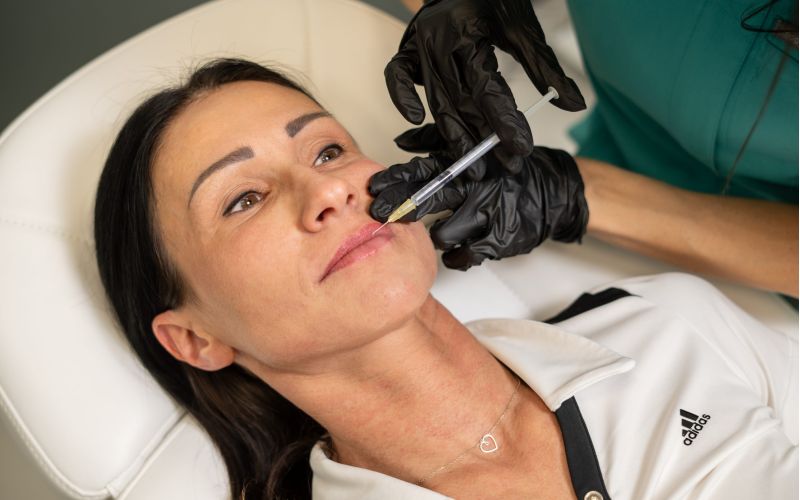
Hyaluronic acid has the ability to bind water, which helps to hydrate the skin and increase its elasticity. This property has found wide use in aesthetic medicine, mainly as a way of reducing wrinkles, enlarging the lips or contouring the face shape. If too much hyaluronic acid has been used in these treatments, it can be broken down with hyaluronidase. What is this enzyme and how does it work?
Table of contents
What is hyaluronidase?
By the simplest definition, hyaluronidase is an enzyme that breaks down hyaluronic acid. It occurs naturally, for example in the venom of hymenopteran insects (such as wasps and bees) and of some snake species; it is also produced by bacteria and by some cells of vertebrates. It works by breaking glycosidic bonds, which leads to the depolymerisation of hyaluronic acid.
Hyaluronidase has been used since the 1950s. Over the years it has found very wide use in medicine. Among other things, the enzyme is used for subcutaneous hydration in older people (as an addition to saline), to increase the absorption of drugs given subcutaneously and to prevent the adverse effects of extravasation of drugs. It is also used to treat nodules and granulomas.
The first use of hyaluronidase in aesthetic medicine dates back to 2004. At that time, an injection of 75 IU of the enzyme and 1.5 ml of 0.5% lidocaine with epinephrine reduced 90% of irregularities and nodules within 24 hours [1]. Today the substance is widely used to remove excessive amounts of filler or to modify the results of previous hyaluronic acid treatments.
When is hyaluronidase used?
Hyaluronidase is usually used when the patient is not satisfied with the results of hyaluronic acid treatments. This is most often related to:
- injection of too much filler, leading to unnatural results,
- incorrect placement of the filler,
- an unsuitable choice of filler,
- facial asymmetry,
- correcting any imperfections after the treatment (e.g. uneven distribution of the filler or lumps appearing on the lips),
- migration of the hyaluronic acid.
Dissolving HA with hyaluronidase may also have strictly medical indications. It is worth mentioning, however, that adverse reactions after hyaluronic acid injections are rare, and their most common causes include incorrect injection technique, lack of asepsis during the treatment, anatomical variations and the body's natural reaction to the presence of a foreign body.
Examples of medical indications for treatment with hyaluronidase include:
- allergy or intolerance to hyaluronic acid (if an allergic reaction occurs immediately after HA has been injected, swelling can be minimised with hyaluronidase injections - which is why it is so important that the treatment is performed by someone who can quickly recognise an allergic reaction and effectively prevent its consequences),
- vascular occlusion or necrosis following injection of the acid,
- overcorrection resulting from injecting the acid too superficially,
- other complications caused by injection of the acid.
What does a hyaluronidase treatment involve?
Hyaluronidase is administered under local anaesthesia, and the whole treatment takes less than half an hour. The previously selected dose of the enzyme is introduced with a fine needle directly into the area with excess filler, which starts the process of dissolving the filler and its natural removal from the body. For many people it will certainly be important that the first effects of hyaluronidase can be seen within several dozen minutes of the treatment. The final result, however, usually takes a few days to appear.
It may happen that hyaluronidase does not bring the expected results. Everything depends on the exact composition of the filler, its amount and depth. Sometimes the doctor needs to choose a higher dose of the enzyme or perform more than one treatment.
Side effects and contraindications to hyaluronidase treatment
The response of a filler to hyaluronidase can vary depending on many factors, including the concentration of hyaluronic acid, the form of the filler and the degree of cross-linking. This is why choosing the right dose of the enzyme and the site where it is injected is so important.
Hyaluronidase treatments are not recommended above all during pregnancy and breastfeeding, in people allergic to hymenopteran venom (because of the risk of cross-reactions), and in severe autoimmune diseases and cancer. The most common side effects associated with the treatment are itching and allergic reactions (the frequency of the latter ranges from 0.05% to 0.69%), which is why skin tests are sometimes recommended before therapy [3].
—
Sources:
[1] Zegarska B., Ambroziak M., Ornatowska M., Barańska-Rybak W., 2020, Postępowanie przy powikłaniach po zabiegach z użyciem kwasu hialuronowego. Rekomendacje Sekcji Dermatologii Estetycznej Polskiego Towarzystwa Dermatologicznego, Przegląd Dermatologiczny
[2] Conings J., 2020, Powikłania po leczeniu wypełniaczami kwasu hialuronowego – przegląd piśmiennictwa
[3] Jung H., 2020, Hyaluronidase: An overview of its properties, applications, and side effects, Archives of Plastic Surgery